
Suing for Peace
Last updated 06:06 AM EDT • Read time: 5m
The United States has recognized defeat in achieving its military goals in the conflict[i] with Iran and is suing for peace.
In discussing this assertion, let’s first review the military goals of the conflict, as laid out by the White House:
- First, we’re destroying Iran’s missile capabilities… and their capacity to produce brand new ones — pretty good ones they make.
- Second, we’re annihilating their navy…
- Third, we’re ensuring that the world’s number one sponsor of terror can never obtain a nuclear weapon…
- And finally, we’re ensuring that the Iranian regime cannot continue to arm, fund, and direct terrorist armies outside of their borders.[ii]
Let’s evaluate the status of each of these military goals in turn:
Missiles: Iran’s ability to launch and manufacture missiles – and drones, it is important to add – has been degraded. Degraded, yes, but not eliminated. In fact, it is unclear exactly what Iran’s remaining offensive weapon capability is. Assessment: This military goal has not been achieved.
Navy. Iran’s Navy has been largely destroyed. However, it is not clear how many of the Fast Attack Craft (FAC) and Fast Inshore Attack Craft (FIAC) of the Iranian Republican Guard Navy have been destroyed, nor is it clear that all of Iran’s mini-subs have been destroyed, or its ability to launch torpedoes and lay mines, or how many of the Coastal Defense Cruise Missiles (CDCMs) remain, or Anti-Ship Ballistic Missiles, or unmanned surface drones. Most importantly, whatever the destruction of Iran’s naval capability might be, enough naval capability clearly remains to maintain sea control over the Strait of Hormuz (SOH), which has become the dominant strategic issue of the conflict. Assessment: This military goal has not been achieved.
Nuclear weapon. It is not clear that Iran’s enrichment of uranium program, which was supposedly “obliterated” in July 2025, has been any more degraded, or its stock of enriched uranium destroyed. Assessment: This military goal has not been achieved.
Proxy organizations. Hamas has been largely rendered ineffective, but not by this conflict; Israel battles Hezbollah in Lebanon, but Hezbollah is not defeated and is not likely to be defeated; and the Houthis in Yemen have been unaffected by this conflict. As to Iran’s ability to “to arm, fund, and direct” these organizations, logic would suggest that has been degraded, but certainly not eliminated. Assessment: This military goal has not been achieved.
For the astute reader that may be counting, that is four-for-four military goals not achieved. Not good.
In addition to these goals, there are other Measures of Effectiveness (MOEs) – what operational and strategic effects have been achieved - that can be used to evaluate how belligerents are faring in a given conflict. For example:
Influence over allies. No: according to mediator Pakistan, the ceasefire applied to the conflict in Lebanon between Israel and Hezbollah; Israel disagreed and continued bombing Lebanon. The U.S. has alternated between trying to convince Israel to – what was the President’s term, “tone it down?” – to denying that the ceasefire applied to operations in Lebanon. Not a good look…
Opening the SOH. By this, the U.S. means to return to the pre-conflict status of free passage through the SOH and said this was a condition of the ceasefire. However, it was clear Iran was not going to give up control of the SOH, and as of this writing, the U.S. hasn’t done anything about this. Not a good look…
Regime overthrown. Is a goal, is not a goal, re-define “regime”? No matter – the political apparatus that was ruling Iran before the conflict is still ruling Iran. Not a good look…
Sea control of the SOH. “Sea control” means a belligerent can use a body of water for their purposes while denying use of that body of water to others to use for their purposes. Iran has firm sea control of the SOH. Not a good look…
Iran collecting fees for ships to transit the SOH? Yes – see previous bullet. Not a good look…
Iranian oil exports increased? Yes – see sea control bullet above. Not a good look…
U.S. allies joining the fight? Not yet, and not likely – at least not in support of the U.S.. Not a good look…
Strong U.S. popular support? No. Not a good look…
U.S. Congress authorized funding for the conflict? Not yet. Not a good look…
U.S. Congress approves of or authorizes conflict? Not yet. Not a good look…
U.S. dictated negotiation terms? No. Not a good look…
Prior to the President’s address to the nation on 1 April, I laid out a face-saving way out of this conflict for the U.S.: what the U.S. should have done was declare victory, accept the China/Pakistan peace plan, and entered into negotiations with Iran as an equal.[iii] Instead, the United States entered a ceasefire and peace negotiations based on terms submitted by Iran. Winning sides do not enter a ceasefire and peace negotiations by accepting the enemy’s terms as the basis of negotiations, especially after failing to meet all of their military goals.
By all indications, the United States of America is clearly suing for peace after co-initiating a failed military campaign.
Anthony Cowden is the Managing Director of Stari Consulting Services and co-author of Fighting the Fleet: Operational Art and Modern Fleet Combat, all royalties from which go to the Navy/Marine Corps Relief Society.
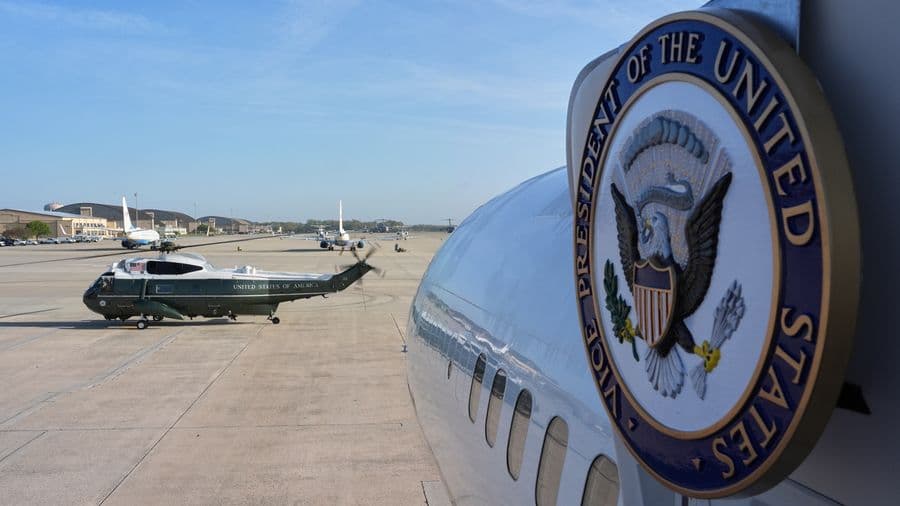
Image: Marine Two, with Vice President JD Vance aboard, arrives, Friday, April 10, 2026, at Joint Base Andrews, Md., where Vance will board Air Force Two, seal right, and departure to Pakistan, for talks on Iran. (AP Photo/Jacquelyn Martin, pool)
Notes:
[i] It took a while for the U.S. to settle on a term for what was happening between U.S. and Israel on one side, and Iran on the other: it couldn’t be called a “war”, as wars are reserved for Congress under the Constitution; it couldn’t be called “hostilities”, as that term is used by the War Powers Act, and the Administration didn’t want to go there; “armed attack” is the term the UN Charter uses, and that was problematic. The Administration finally settled on. “military operation”, which is technically true but a little disingenuous…

ICE Is Not a Four-Letter Word
By Meda Parameswara Reddy • RealClearDefense
The U.S. Can Draw Down in the Middle East Without Going Blind
By Cudi Zerey • RealClearDefense
America Needs a Joseph Directive
By Jeff Ballabon • RealClearDefense
Partnering Decides Whether Flexible Military Construction Can Work
By Matt Russell • RealClearDefense
Eight Months of Epic Fury and Still No Internal Alternative
By Stephen D. Cook • RealClearDefense

GE Aerospace to Supply Engines for Two US Navy Flight III Destroyers
By Defense Post
U.S. Air Force Asks Industry for New Cruise Missile for Ukraine
By Michael Peck, DNews
First Flight II San Antonio-class Amphib Completes Builder’s Trials
By Mongilio, USNI N.
LGM-35 Sentinel ICBM on Track for 2030
By Kris Osborn, Warrior Maven
On American Destroyers, Avoid a Self-Inflicted Wound in Spain
By Defense News