
U.S.-Iranian Nuclear Talks: Three Headaches
Last updated 08:03 AM EDT • Read time: 5m
Although nuclear talks with the Iranians will resume today, there are already major disputes as to what’s been agreed to so far. Beyond these disputes, two additional major issues—the need for country-wide, intrusive inspections and for tighter controls over Iran’s spent reactor fuel—have yet to be joined.
First, the disputes.
The administration says Tehran has agreed to International Atomic Energy Agency (IAEA) inspections of Iran’s bombed uranium enrichment sites. Iran insists there is no such agreement.
The White House says it wants to destroy Iran’s stockpiles of highly enriched uranium. Iran says it will only blend it down.
Administration officials insist Iran has no inalienable right to enrich. Iran insists it has it and intends to exercise it.
The administration wants Iran to ship the bulk of its enriched uranium to a third country. Iran says it will never allow this material to leave its soil.
Resolving these disputes constitutes the first headache. Then, there’s what’s yet to be discussed.
The first bit missing is the need for country-wide, intrusive inspections. It’s estimated that Iran has built between 30,000 to 40,000 gas centrifuges. Iran only needs a few hundred centrifuges to convert the enriched uranium it’s already has into weapons-grade uranium. Might Iran have hidden this many or more centrifuges at undeclared sites? What of its extensive stockpile of enriched uranium? Do we know where all of this material is? Neither the IAEA nor any US allied intelligence agency can say for sure.
The only way to get the answer is to conduct comprehensive, intrusive nuclear inspections of all of Iran. These inspections should be similar to that imposed on Iraq after it lost the second Gulf War. Neither the United States nor Iran have yet joined this issue.
Yet another worrisome matter is Iran’s power reactor at Bushehr. It has produced enough plutonium to fuel more than 200 nuclear warheads. The amount of time and effort to extract this plutonium from the spent fuel and convert it into warheads is roughly the same as what Iran would need to do to produce uranium bombs.
Unfortunately, routine IAEA nuclear safeguards inspections only occur every 90 days—a period within which Iran could divert the stored spent fuel containing weapons usable plutonium and chemically strip this material out from other radioactive byproducts in the spent fuel. Even increasing onsite inspections to one a month, would still leave more than enough time for Iran to divert and convert the spent fuel into nuclear weapons plutonium cores.
A fix here would be to subject Iran’s reactors and their spent fuel storage sites to near real-time surveillance. More than 30 countries already authorize the IAEA to conduct such surveillance of their nuclear facilities. It entails installing cameras and sensors that send images and data in a secure manner every few minutes to a station located outside of the inspected country. If the lights go off, if the cameras’ view is blocked, or if the sensors or cameras fail, IAEA officials would know within minutes—not months or days—and could dispatch inspectors to the site immediately.
The good news is Iran agreed in 2015 to allow such surveillance of its enrichment plant at Natanz. At the time, the Obama Administration, though, failed to ask for such surveillance of Iran’s power reactor at Bushehr. The IAEA subsequently asked Iran to permit such surveillance of the reactor. Iran refused. So far, Trump’s negotiators haven’t publicly raised the issue.
The second missing bit is the need to remove Iranian reactor spent fuel laden with weapons usable plutonium. Russia offered to take back Iran’s spent fuel when it contracted to build Bushehr. The Iranians, however, never availed itself of Moscow’s offer. U.S. negotiators should demand it. The United States and Iran’s neighbors could help pay for removing the spent fuel either to Russia or Kazakhstan, which has already offered to take Iran’s enriched uranium.
Unfortunately, none of these nettlesome issues have been properly joined. Given Iran’s contrarian nuclear disposition, ignoring these issues is a prescription for mischief. At the very least, the United States should clarify what making Iran nuclear weapons free actually requires.
Will Washington get all that it asks for? Probably not. But if it pulls its punch on what’s necessary to denuclearize Iran, it will have even less luck keeping Iran’s neighbors—e.g., Saudi Arabia, the United Arab Emirates, Turkey, and Egypt—from following Iran’s model. In that case, the United States will have to face not just a near-nuclear armed Iran, but a Middle East full of nuclear Iran wannabes. Our security headaches then will be far harder to cope with.
Henry Sokolski is executive director of The Nonproliferation Policy Education Center in Arlington, Virginia, served as the Pentagon’s Deputy for Nonproliferation Policy, and is the author of China, Russia and the Coming Cool War (2024).
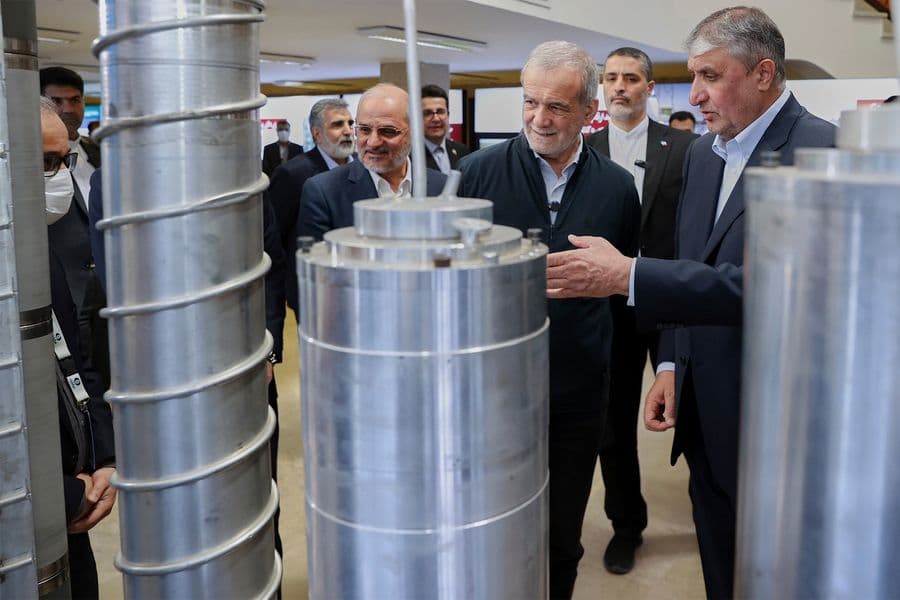
image: In this photo released by the Iranian Presidency Office, President Masoud Pezeshkian, second right, listens to head of Atomic Energy Organization of Iran Mohammad Eslami as he visits an exhibition of Iran's nuclear achievements, in Tehran, Iran, April 9, 2025. (Iranian Presidency Office via AP, File)

The Services Do Not Need a Four-Star Autonomous Warfare Command
By Steven Wills • RealClearDefense
Honor Them While There Is Still Time
By Jeffrey Rosales • RealClearDefense
From Siberia to Fairford: How Operation Spider’s Web Has Changed the Rules of Airpower
By Frank A. Rose • RealClearDefense
Faster Simulations, Better Defense Decisions
By Rut Lineswala • RealClearDefense
Will HASC Have an Oversight Subcommittee in the Next Congress?
By Christopher J. Bright • RealClearDefense
Hegseth Barred Trans Troops. Military Boards Are Rejecting Those Orders.
By NYT
Closing the Sea: Lessons from Ancient Mediterranean Blockades
By DeCasien, CIMSECFrom Siberia to Fairford: How Operation Spider’s Web Has Changed the Rules of Airpower
By Frank A. Rose • RealClearDefenseFaster Simulations, Better Defense Decisions
By Rut Lineswala • RealClearDefense
Bombers Could Have a Major Air-to-Air Combat Role
By Joseph Trevithick, The WarZone