
Neocons' Lawyer Criticizes Trump National Security Strategy
Last updated 07:54 AM EST • Read time: 5m
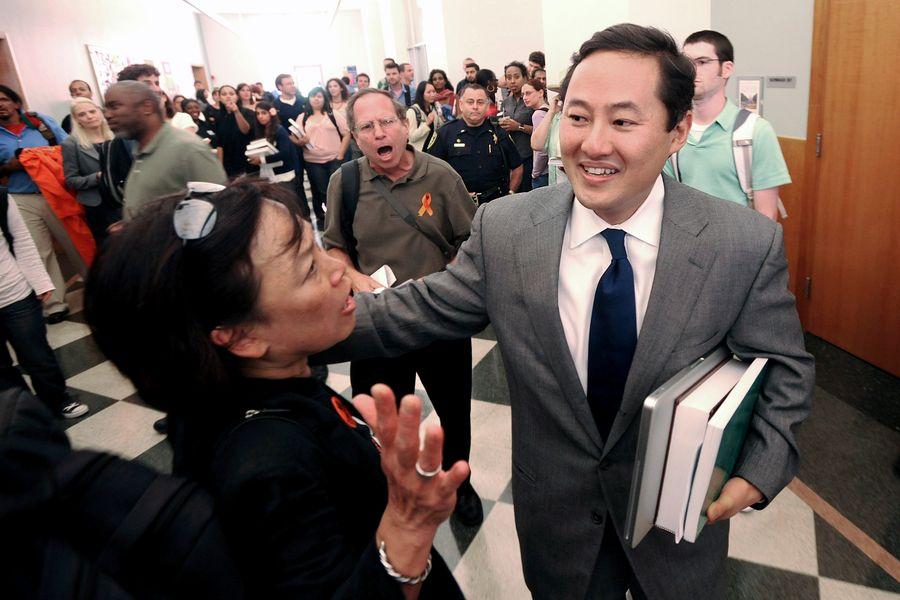
John Yoo, a former lawyer in the Bush 43 administration who provided legal cover for the endless wars in Iraq and Afghanistan and the Global War on Terror and is now a senior research fellow at the University of Texas’ Civitas Institute, describes what he calls the “good, the bad, and the ugly” of the 2025 Trump National Security Strategy. The good, he writes, is “the NSS’s recognition of the fundamental goal of U.S. national security policy: the defense of American sovereignty.” The bad, he says, is the “confused, at times contradictory, approach” to China. The ugly, Yoo contends, is the NSS’s “dismissive attitude toward” our allies. The truth, however, is that John Yoo, the neocons’ lawyer, doesn’t like a National Security Strategy that really puts America First.
Even before he became a lawyer in George W. Bush’s administration, Yoo wrote a paper justifying the Clinton administration’s interventions in Bosnia, Afghanistan, Sudan, Iraq, Haiti and Somalia. As Bush 43’s lawyer, Yoo became the administration’s legal voice in support of waging wars to spread democracy and nation-build, wasting American lives and American treasure in the process. It is no wonder that the neocons’ lawyer doesn’t like an NSS that raises a presumption against interventions abroad, wants our allies in Europe, the Middle East, and Asia to increase their contributions to their own defense, and prefers peace to war.
Yoo acknowledges the importance of protecting the homeland and promoting hemispheric security. “The Trump administration,” he grudgingly writes, “has focused on protecting the homeland as perhaps no other in memory has.” Trump, Yoo admits, “has restored control over the southern border and brought illegal migration almost to a complete stop.” Trump has also revitalized the Monroe Doctrine, a move Yoo also praises. But the praise ends there because, according to Yoo, the Trump administration “lacks clear strategic goals beyond defending the homeland and the western hemisphere.”
But the Trump NSS sets forth clear strategic goals beyond protecting the homeland and hemispheric security. John Yoo just happens to disagree with those strategic goals because those goals depart significantly from the neoconservative, Wilsonian world view. The 2025 NSS says nothing about promoting democracy or nation-building. It recognizes, as Yoo does, that our European allies have the resources to defend themselves, but whereas Yoo would have the U.S. continue to be the primary guarantor of Europe’s security, the Trump NSS insists on real burden-sharing where Europeans take primary responsibility for their own defense. This shift in burden sharing, the NSS insists, applies equally to the war in Ukraine—a war, unsurprisingly, that Yoo wants the U.S. to become more involved-in on Ukraine’s side.
Yoo has the gall to invoke George Kennan, of all people, in support of his view that Trump is being dismissive of our European allies. Kennan, of course, was against a militarized NATO from its inception, and proposed in the early 1950s that Soviet and American forces disengage from Europe. Kennan was also among the many Russian and security experts that opposed NATO enlargement after the Cold War ended. Kennan also recognized that Ukraine was of much greater interest to Russia than to the U.S.
Yoo acknowledges that the 2025 NSS notes the importance of defending Taiwan’s independence and ensuring that the South China Sea remains open, but criticizes the paper for not naming China as the threatening power. Of course, the NSS does name China in the section on Asia where it discusses economic competition and the need to prevent military confrontation. There, the NSS reaffirms the U.S. commitment to a “free and open Indo-Pacific.” It is also there where the NSS calls the Indo-Pacific a key “economic and geopolitical battleground.” And in the economic section of the paper, the NSS again names China as an economic competitor, calls for rebalancing our economic relationship with China, but also states that this “must be accompanied by a robust and ongoing focus on deterrence to prevent war in the Indo-Pacific.” Anyone who reads the entire document knows that the threat to Taiwan and the South China Sea comes from China. Yet Yoo writes: “[B]y refusing to name the potential enemy, the Trump administration cannot provide a strategy that explains why China is the enemy.” All this shows is the intellectual depths Yoo will sink to in order to level criticism at Trump’s NSS.
One wonders whether John Yoo had any hand in drafting the Bush 43 National Security Strategies. The 2006 NSS, for example, stated that the United States would “support democratic movements and institutions in every nation and culture, with the ultimate goal of ending tyranny in our world” and “The goal of our statecraft is to help create a world of democratic, well-governed states that can meet the needs of their citizens and conduct themselves responsibly in the international system” and “promoting democracy is the most effective long-term measure for strengthening international stability; reducing regional conflicts; countering terrorism and terror-supporting extremism; and extending peace and prosperity” and “the United States seeks to extend freedom across the globe by leading an international effort to end tyranny and to promote effective democracy.” If Yoo didn’t participate in this document’s drafting, he nevertheless supported and legally justified Bush’s measures designed to implement the document’s utopian goals.
It is no wonder that John Yoo doesn’t like Trump’s more restrained and more realistic NSS that puts not the world first, but America First.
Francis P. Sempa writes on geopolitics.
2949 Marine Prisoners, Hostages, and Peacetime Governmental Detainees Since Our Corps' Founding
By Jon Couch • RealClearDefense
America Must Win the Biotech Race Against China
By Rob Maness • RealClearDefense
How Digital Twins Can Strengthen Naval Readiness Before a Crisis Begins
By Carl Napoletano • RealClearDefense
The Uninsured Sky
By Joe Sandri • RealClearDefense
Counterterrorism and the Growing Convergence in Homeland Security and Homeland Defense
By Austin Doctor • RealClearDefense
How Digital Twins Can Strengthen Naval Readiness Before a Crisis Begins
By Carl Napoletano • RealClearDefense
F-16s Build on Iran Combat Lessons to Prepare for China Threat
By Rebecca Grant • Lexington Institute
U.S. Aircraft Evacuated From Second U.K. Base Due to Iran Threat
By Holliday, et al, WSJ
US Marine Corps Acquires Textron’s Ripsaw M3 Uncrewed Ground Vehicles
By DPost
U.S. Navy’s First San Antonio Flight II USS Harrisburg Completes Sea Trials
By GDN