
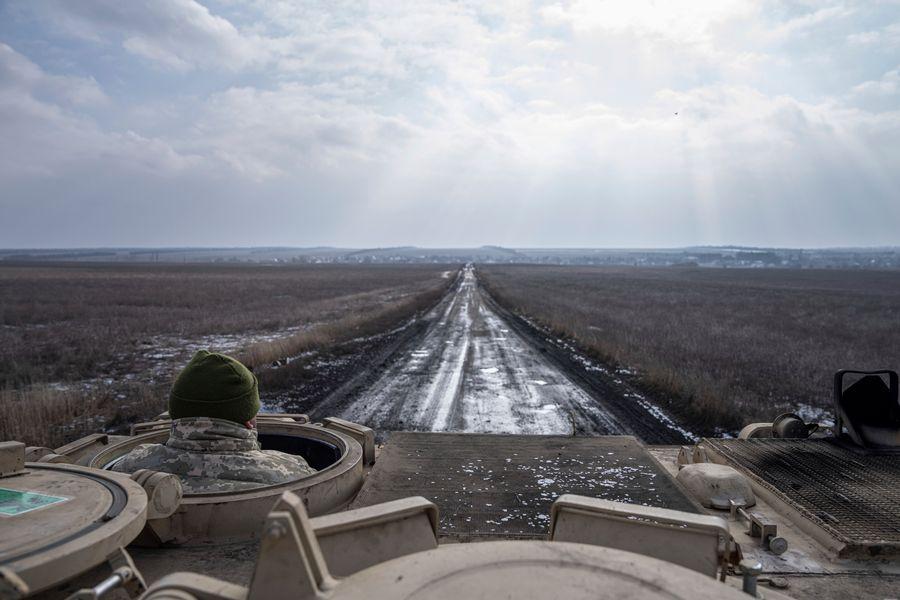
Trump May Surprise Us on the Ukraine War
Published Oct. 3, 2024 • Read time: 6m
If Donald Trump can’t achieve a quick solution in Ukraine, he
could well turn on Putin and increase U.S. support to Ukraine.
This article also appears in a collection of essays, Harris v Trump, written by Lowy Institute experts on the implications for Australia of the U.S. presidential election.
The timing of the U.S. presidential election in November and the inauguration of the next U.S. president in January will likely coincide with a lower tempo period in the Ukraine war as both sides hunker down for the winter. This does not mean that the fighting stops, but it does mean that military activity will appear to decline relative to the higher tempo spring and summer months. It is likely neither side will be able to make decisive inroads during this time. While a re-elected Democratic administration may continue its current level of support for Ukraine even if it is unclear who is winning the war, what might a newly elected Trump administration do?
Russia’s stalled momentum
Over the last seven months, Russia has attempted to exploit the failure of the 2023 Ukrainian counter-offensive, the late 2023 civil-military crisis in the Ukrainian government, and the long debate on U.S. aid to Ukraine that deprived the Ukrainians of much needed munitions and equipment in early 2024. The Russian military has been conducting a large-scale offensive campaign on the ground and in the air to pummel the Ukrainian military and to influence the political calculus of Ukraine’s government and its Western supporters.
But for all its efforts, and the loss of 180,000 troops in that time, Russia has only made minor territorial gains. It has not changed the willingness of the Ukrainian military to fight, or the will of the Ukrainian government to continue its defence against what they view as an existential war being waged upon them.
Russia Says Its Defenses Intercepted Over 1,300 Ukrainian Drones
How Seoul’s Break With Kyiv Serves Trump’s Russia Turn
The First Test of Peace Lies in Ukraine's Borderlands
Ukraine Abandons Truce and Attacks Russian Oil Refinery
As Russia’s current offensives continue but begin to lose momentum, Ukraine has been focused on the reconstitution of its forces in the wake of the 2023 counter-offensive and a long and bitter debate over mobilisation. The Ukrainians, however, have recently shocked the Russians, and their supporters, with a major operation in Russia’s Kursk Oblast.
Four factors will influence the war in 2025
Four things will have a major influence on the war.
The first is the impact of Russia’s ongoing offensive and whether it will take additional territory before the Russian ground forces culminate. While the prospect of a Russian breakthrough cannot be discounted, Moscow will most likely continue to undertake assaults on multiple axes, which will force Kyiv to commit troops and firepower it would prefer to preserve for the offensives to come.
A second influence will be the outcome of the ongoing Ukrainian operation inside Russia’s Kursk Oblast. Having already humiliated Putin and the Russian army with their surprise attack last week, Ukraine has multiple options for how it can politically and strategically exploit its successes in this new operation.
A third impact on Ukraine’s 2025 operations will be the winter. Ukrainians have a miserable winter coming because of Russia’s destruction of about 50 per cent of the country’s power-generating capacity needed for the winter months. This will have a political impact on Ukrainians’ view of their government and the war. The winter will also be a time when both the Ukrainian and Russian militaries will be conducting long-range strike operations and making final assessments, plans, and logistic stockpiling for ground operations in the spring.
However, while the Ukrainian Kursk operation is attempting to change the status quo in the war, the biggest impact on the dynamics of the conflict could be a return of Donald Trump to the White House.
Trump camp’s views on Ukraine
There are some indicators about which way a second-term President Trump might lean. Presidential candidate Trump has claimed that he would end the Ukraine war quickly if he were elected. A plan drawn up by two former members of Trump’s National Security Council staff, Keith Kellogg and Fred Fleitz, proposes a ceasefire based on current frontlines on the battlefield, however this is not known to have been endorsed by Trump.
Vice-presidential candidate JD Vance has been very open about his views on Ukraine. After Russia invaded Ukraine in February 2022, Vance stated that “I don’t really care what happens to Ukraine one way or another.” And, in a New York Times opinion piece in April 2024, Vance wrote that “Ukraine’s challenge is not the GOP; it’s math. Ukraine needs more soldiers than it can field, even with draconian conscription policies. And it needs more matériel than the United States can provide. This reality must inform any future Ukraine policy.”
Notwithstanding the apparently cordial Zelensky–Trump phone call in the wake of the Republican National Convention, a Trump administration will be difficult to navigate for the Ukrainians. In the most recent Pew Research Center survey, published in May, less than half of Republican Party voters have a favourable view of NATO compared to 75 per cent of Democratic Party voters. Nearly half (49%) of Republican voters believe the United States is giving too much aid to Ukraine.5
If these sentiments are taken together with Trump’s role in encouraging a four-month interruption in U.S. assistance to Ukraine in 2023, his assertions that he would let Russia “do whatever the hell they want” to NATO countries that did not spend enough, and his recent comments about Taiwan not paying America enough to guarantee its defence, a picture begins to form about how a U.S. administration under Trump might approach the world. But it remains an opaque view at best.
Quick solutions will prove elusive
The Russians have previously stated that any peace plan proposed by a Trump administration would have to reflect the reality on the ground in Ukraine, but that Putin remains open to talks. To this must now be added the reality on the ground in Kursk. However, should Trump not be able to achieve a quick solution in the Ukraine war, he could well turn on Putin and increase U.S. support to Ukraine.
There is much that might happen to impact voter intentions between now and the November election. But one thing is certain. The Ukrainians understand what is at stake if they lose Russia’s war of aggression. Even if a Trump administration attempts to force them into an unsustainable armistice, Ukraine would likely choose to fight on without U.S. support. That is still a better option than subjecting themselves to what is likely to be only a short-term reprieve from ongoing Russian predation.
Mick Ryan is a Senior Fellow for Military Studies in the Lowy Institute’s International Security Program. Mick spent 35 years in the Australian Army and had the honour of commanding soldiers at multiple levels. His operational service includes deployments to East Timor, Iraq, and southern Afghanistan, and he also served as a strategist on the United States Joint Staff in the Pentagon.
This article appeared originally at Lowy Institute's the interpreter.
Iron Raven: Remembering Colonel Joseph B. Conmy, Jr.
By Louis Marano • RealClearDefense
Stand Proud of the Force
By Jay Rogers • RealClearDefense
How a Dying Agency Turned Fentanyl Into a Weapon of Mass Destruction
By Barry Angeline • RealClearDefense
The Pressure Is the Message: What Xi and Putin Faced in Shenzhen
By Emzari Gelashvili • RealClearDefense
China’s Revised Mobilization Law and the Expanding Reach of National Defense
By Muhammad Shoaib • RealClearDefense

Marine Corps Hero Under Federal Investigation
By Laporta, Burnham & Watson, CBS
A Postmortem of Maneuver Warfare in the U.S. Marine Corps
By Donald Vandergriff
U.S. Putting Weapons in Space: A Strategic Blunder?
By Ajey Lele • RealClearDefense
U.S. Senate Seeks to Exchange Shipbuilding Funds for More Munitions
By Naval News
F-35C Completes First Launch and Recovery Trials on a Ford-Class Carrier
By Navy T.