
Pakistan's Intelligence Service 'Has Connections With Terrorist Groups'
Published Oct. 5, 2017 • Read time: 3m
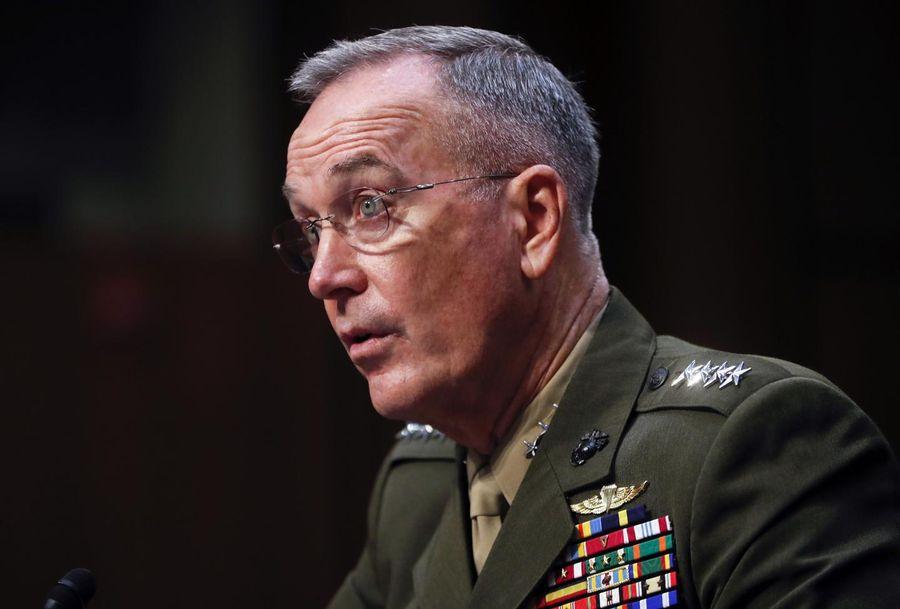
During a hearing yesterday in front of the Senate Armed Services Committee, General Joseph Dunford, the Chairman of the Joints Chiefs of Staff said that Pakistan’s Inter-Services Intelligence Directorate (ISI) continues to support terrorist groups. Despite this announcement, Dunford and Secretary of Defense James Mattis remain hopeful that the US can rein in the rogue nation.
Mattis and Dunford placed all of the blame for Pakistan’s support of terrorist groups on the ISI, and essentially absolved Pakistan’s government and the military of any responsibility for both incubating and supporting regional and global jihadist organizations.
When asked if “the ISI is still helping the Taliban,” Dunford responded that “it’s clear to me that the ISI has connections with terrorist groups.”
Mattis also noted Pakistan’s complicity with terrorist attacks in South Asia.
“Pakistan has a convoluted history with terrorism. There can be little doubt that there have been terrorist groups that have used Pakistan as a haven for attacks outwardly, and not just towards Afghanistan. We’ve seen the attacks on India, as well,” Mattis stated.
Later on, Mattis said that the “ISI appears to run its own foreign policy.”
Mattis and Dunford went out of their way to praise the Pakistani military and government for “fighting terrorists,” but they failed to explain that the Pakistani state only battles jihadists groups that threaten it, such as the Movement of the Taliban in Pakistan and the Islamic Movement of Uzbekistan. These groups are referred to as “bad Taliban,” as they attack the Pakistani state.
How a Dying Agency Turned Fentanyl Into a Weapon of Mass Destruction
Congress Must Reauthorize Section 702 of the Foreign Intelligence Surveillance Act
Counterterrorism and the Growing Convergence in Homeland Security and Homeland Defense
Washington Cannot Ignore Afghanistan’s Weapons Legacy
While the ISI is a driving force in devising and executing Pakistan’s policy of supporting terrorist outfits such as the Afghan Taliban, Lashkar-e-Taiba, Harakat-ul-Mujahideen, Hizbul Mujahideen, and other groups, the government and the military support these efforts. The ISI is, after all, an arm of Pakistan’s military. Yet the military and government cannot or will not rein it in. These groups, which are referred to as “good Taliban,” are used by the Pakistani state to execute its foreign policy goals of weakening India’s control of Kashmir and Jammu, and establishing a pro-Pakistan Taliban government in Afghanistan.
Despite Pakistan’s decades-long support of jihadist outfits in South Asia, Mattis and Dunford stressed that a diplomatic approach would be the prime vehicle used to attempt to ween the country from its policy of supporting terrorists. Dunford praised General Qamar Javed Bajwa, Pakistan’s Chief of Army Staff, the country’s most powerful military leader, for recently engaging Afghan leaders in Kabul.
“We were encouraged, just this week, with General Bajwa’s visit to Afghanistan,” Dunford stated. “He was in Kabul the day before yesterday. He had very good meetings with Afghan leadership. Our leadership was engaged in those meetings as well. There’s at least a commitment, now, to address those issues and do better coordination along the border area.”
However, over the years, there have been numerous visits to Kabul by Pakistani military leaders and government officials. These visits have not borne any fruit, and in fact the Taliban is stronger today in Afghanistan than any point since the US invasion in the fall of 2001. The group controls or contests an estimated 45 percent of Afghanistan’s districts, according to a study by FDD’s Long War Journal.
If Pakistan is serious about showing good faith in fighting terrorism and stabilizing South Asia, it should start by arresting the Taliban’s leadership, and closing the training camps, madrassas, recruiting centers, financial hubs, and other support networks that are based within its border.
Bill Roggio is a Senior Fellow at the Foundation for Defense of Democracies and the Editor of FDD's Long War Journal.
This article appeared originally at FDD's The Long War Journal.

Iron Raven: Remembering Colonel Joseph B. Conmy, Jr.
By Louis Marano • RealClearDefense
Stand Proud of the Force
By Jay Rogers • RealClearDefense
How a Dying Agency Turned Fentanyl Into a Weapon of Mass Destruction
By Barry Angeline • RealClearDefense
The Pressure Is the Message: What Xi and Putin Faced in Shenzhen
By Emzari Gelashvili • RealClearDefense
China’s Revised Mobilization Law and the Expanding Reach of National Defense
By Muhammad Shoaib • RealClearDefense

Marine Corps Hero Under Federal Investigation
By Laporta, Burnham & Watson, CBS
A Postmortem of Maneuver Warfare in the U.S. Marine Corps
By Donald Vandergriff
U.S. Putting Weapons in Space: A Strategic Blunder?
By Ajey Lele • RealClearDefense
U.S. Senate Seeks to Exchange Shipbuilding Funds for More Munitions
By Naval News
F-35C Completes First Launch and Recovery Trials on a Ford-Class Carrier
By Navy T.