
What's Really Behind the Shooting of Miguel Uribe?
Published June 13, 2025 • Read time: 10m
An Assassination Attempt, a Convenient Crisis
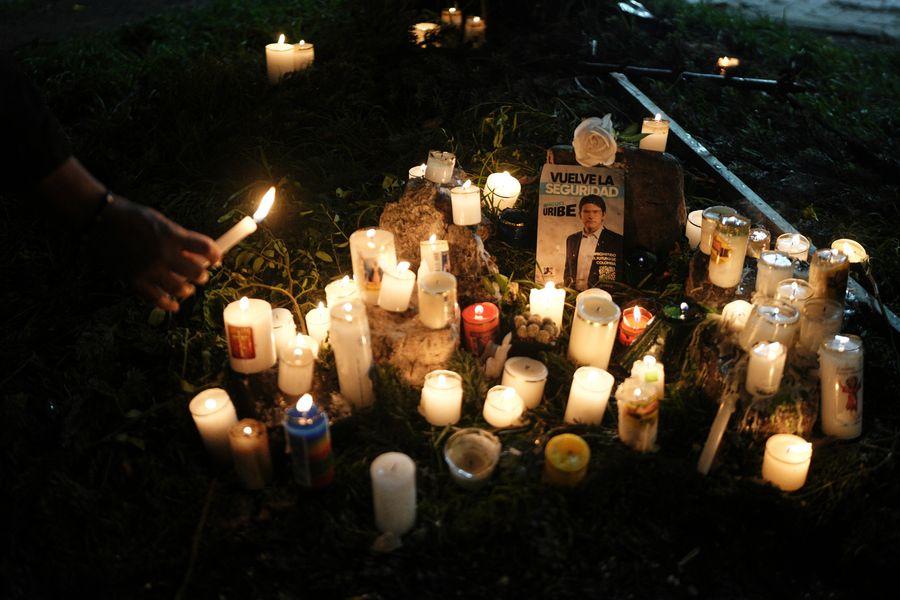
On June 7, 2025, Colombian senator and presidential pre-candidate Miguel Uribe Turbay was shot in the back and head while campaigning in Bogotá. After a shootout, a 14-year-old shooter was arrested. In a video recorded at the scene, the shooter appears to offer an immediate confession, telling the bodyguards and police officers that he would "reveal numbers." The official narrative wrapped itself almost instantly around the event: an act of political violence, met with condemnation by President Gustavo Petro and his allies and an assurance that he would hunt the intellectual authors no matter where they were. But the circumstances are too orderly, the confession too convenient, and the political timing far too perfect to dismiss as random.
This attack comes only days after Petro suffered a humiliating setback: his labor, pension, and energy reforms were rejected by the Senate. Rather than negotiating, he responded by proposing a national referendum by decree, citing a murky Constitutional Court ruling. Even more audaciously, Petro floated the idea of a constituent assembly— to effectively rewrite the constitution—through public assemblies, bypassing Congress entirely. Legal experts, ex-presidents, and senior jurists denounced his approach as unconstitutional and dangerous to the separation of powers.
In this moment of institutional crisis, the shooting abruptly redirected national attention—away from Petro’s attempt to bypass Congress and to the increasing reality of public insecurity. But the political value of the target cannot be overstated. While Miguel Uribe is an opposition senator and former Bogotá mayoral candidate with national visibility, he is not the most electorally disruptive threat to Petro’s presidency. That distinction belongs to María Fernanda Cabal, a hardline senator with entrenched support among evangelical churches, conservative rural elites, and retired military officers.
How a Dying Agency Turned Fentanyl Into a Weapon of Mass Destruction
Congress Must Reauthorize Section 702 of the Foreign Intelligence Surveillance Act
Counterterrorism and the Growing Convergence in Homeland Security and Homeland Defense
Washington Cannot Ignore Afghanistan’s Weapons Legacy
Where Uribe emphasizes procedural restraint—challenging Petro’s agenda through congressional votes, constitutional objections, and economic critique—Cabal casts the Petro government as an existential threat to the republic. She has called for civil resistance, arguing that Colombia’s institutions are being hollowed out by authoritarian legalism. Her push to abolish the Special Jurisdiction for Peace (JEP)—which she denounces as a “platform for guerrilla impunity”—stands in direct contrast to Uribe’s call for targeted reforms that preserve its legitimacy. The divide is not just tactical but geopolitical: Cabal draws from nationalist-populist networks critical of the UN, human rights NGOs, and liberal multilateralism, while Uribe projects an Atlanticist image, appealing to foreign investors and constitutional order. This cleavage has intensified internal tensions over the Democratic Centre’s identity: whether it should rebrand as a credible, center-right governing party or embrace populist polarization as its electoral engine. For Cabal, Uribe represents a failed establishment tethered to elite caution; to Uribe, Cabal risks turning the party into a reactionary outlier—isolated from courts, allies, and international norms.
Equally important, Miguel Uribe is not prominent enough to be canonized as a national martyr, nor threatening enough to trigger mass unrest or an armed insurrection. That makes him the ideal target—not for eliminating a presidential contender, but for initiating a broader purge of the opposition. If the goal was to shift the narrative and discredit dissent, Uribe offers maximum symbolic impact with minimal destabilizing risk. In fact, pro-government social media accounts are already claiming that the attack was orchestrated by María Fernanda Cabal and her allies—framing it as an internal right-wing power struggle aimed at clearing her path to the presidency. This narrative provides Petro’s government with a powerful pretext to escalate persecution against his critics under the banner of preventing further political violence. The playbook is familiar: Colombia has seen this precise choreography before—where an act of violence against a secondary figure becomes the catalyst for state repression cloaked in the language of democratic defense.
In 1948, the assassination of populist leader Jorge Eliécer Gaitán sparked riots that led to a decade-long civil war. In 1989, presidential front-runner Luis Carlos Galán was assassinated by a nexus of drug traffickers, state intelligence actors, and rival political machines—just months before the vote. In both cases, the official narratives were incomplete, and the real beneficiaries were those who exploited the chaos to redraw the rules of power.
One decision, initially puzzling, now appears ominously prescient. In February 2025, Petro appointed General Pedro Sánchez—an active-duty Air Force officer—as Minister of Defense, the first such appointment since the early 1990s. Though the Constitution does not formally require civilian leadership, post-1991 democratic practice has consistently favored it to ensure military subordination to elected authority. The move surprised many. Petro—a former M-19 guerrilla—had spent his first year in office removing 52 senior officers, including 27 generals, through a process that bypassed the standard promotion board outlined in Decree 1790 of 2000 and ignored Senate confirmation, likely violating Article 173, Clause 2 of the Constitution. Those removed were disproportionately U.S.-trained veterans of Plan Colombia; in their place, Petro elevated officers with backgrounds in human rights and transitional justice—credentials often peripheral to operational command. This restructuring preserved the military’s institutional shell while eroding its strategic autonomy, concentrating coercive power in politically aligned hands.
But in light of recent events, the rationale is coming into focus. With institutional resistance mounting, electoral legitimacy in question, and unrest increasingly plausible, appointing a loyal general to head the security apparatus appears less a compromise than a calculated contingency—designed to position the armed forces for consolidation of power in the event of political rupture or orchestrated crisis.
In parallel, the legal system itself has been quietly inverted to serve executive power under the appearance of institutional continuity. Colombia is not undergoing legal collapse, but legal repurposing— institutions remain intact, but their restraining functions have been neutralized, enabling expansive executive discretion behind a façade of legality. Since 2022, the state has negotiated with groups like the EMC and AGC—long deemed criminal—prior to any demobilization, classification, or political recognition, bypassing disarmament, confessions, and reparations. Arrests were suspended and extraditions frozen without judicial mandate and prosecutorial oversight. Between 2021 and 2023, the EMC grew from 14 to 26 substructures and extended its reach from 117 to 172 municipalities. Cocaine production surged 53% in 2023 to a record 2,664 metric tons—driven not just by global demand, but by a legally engineered vacuum. Homicides rose in key conflict zones like Cauca, Nariño, and Arauca, while kidnappings—particularly for extortion and political leverage—resumed after years of decline.
Under Petro, the DNI has been weaponized for political control. Manuel Casanova initiated purges of career counterintelligence officers, authorized covert surveillance from a luxury Bogotá apartment, diverted black-budget funds into off‑books contracts, and manipulated threat assessments to protect allies. His successor, Carlos Ramón González—also an ex‑M‑19 militant—was later implicated in the UNGRD bribery scandal and is now a fugitive: the Attorney General's office alleges he orchestrated the diversion of funds from the National Unit for Disaster Risk Management to bribe congressional leaders Iván Name and Andrés Calle and that he has now fled Colombia, likely finding refuge under the Nicaraguan regime. González is formally under investigation and a judge has requested his capture after IP tracking placed him in Managua.
And then there is the most damning detail of all: the confession. The idea that a shooter would immediately disclose a political conspiracy to the bodyguards—without legal counsel, without interrogation, within minutes of capture—defies basic logic. In Colombia, minors have often been used by organized crime and armed groups as disposable tools. They are rarely sources of immediate intelligence, and they are routinely coached or coerced or have their families threatened. The fact that this confession included a promise to “name numbers” only adds to the suspicion: it sounds less like a suspect cracking under pressure, and more like someone performing a script designed to validate a broader narrative.
Notably, the 14‑year‑old shooter had been enrolled in Jóvenes en Paz, a flagship program of the Petro administration aimed at steering vulnerable youth. While its official aim is rehabilitation, the program operates in political terrain where the lines between social outreach and ideological mobilization are blurred. In practice, Jóvenes en Paz has become a mechanism not merely for preventing violence but for managing the margins of the state—redirecting vulnerable youth not away from politics, but into alignment with the government’s strategic priorities. In fact, the program serves as breeding ground for “Chavista-style militias”—not in the sense of armed insurgency, but as a paramunicipal force of ideological enforcement and social intimidation, structurally embedded within the state but functionally loyal to the executive.
The shooting solves multiple problems for Petro: it creates a crisis, undermines the opposition, and provides a rationale for exceptional executive action in the run-up to the 2026 elections. And it came precisely when the constitutional order was pushing back against his power.
The United States cannot afford to treat Colombia’s unraveling as a local anomaly. Its collapse would ignite a transnational criminal infrastructure already entrenched in five countries and two oceans. In Ecuador, cartel-aligned police and customs officials in El Oro province facilitate the uninterrupted export of Colombian cocaine. The armed seizure of TC Televisión in 2024 underscored the operational reach of criminal networks into urban strongholds and state institutions.
In Peru, state authority is disintegrating. Since 2016, six presidents have fallen, and radical factions linked to the Shining Path have re-entered public institutions. In the south—particularly in regions with deep narco-trafficking roots—secessionist demands have surfaced. Between 30% and 70% of gold exports from Madre de Dios are laundered via falsified invoices and phantom mining concessions backed by narco-capital, rendering illegal gold a safer and more lucrative commodity than cocaine: a single large dredge can yield $300,000/month in gold. El Callao, the strategic Pacific gateway of South America, now functions as a cartel logistics hub. Its protection hinges on entrenched judicial networks exposed in the Cuellos Blancos del Puerto scandal, which implicated high-ranking Supreme Court justices in cocaine trafficking cases.
Meanwhile, Mexican cartels offer Colombian farmers as much as $3,000 per acre to cultivate coca and employ retired Colombian special forces to train sicarios—thereby exporting Colombian tactical expertise throughout the region. Financial penetration complements territorial control. Gota and gota networks now operate as cartel shadow banks, issuing high-interest microloans enforced via apps like CobrarApps and PagAppDiario—using GPS tracking, defamation, and coercion into drug trafficking. In Colombia, only 34% of adults have access to formal credit, and fewer than 13% of microenterprises use banks. In Peru, 71% of workers are informal, leaving 12 million excluded from state-backed loans. Brazil adds 40 million unbanked adults. Financial exclusion has become a lever of criminal governance.
If Colombia falls into Petro's authoritarianism or internal war, the Andean ridge will not just fragment—it will fuse into a criminalized conflict ecosystem. Washington would face not a policy dilemma, but a strategic emergency spanning. Moreover, there will be secondary impacts on regional energy, migration, and security systems. The Trans-Andean oil pipeline in Ecuador, the NorPeruano pipeline, and Colombia’s own Caño Limón–Coveñas are all vulnerable to sabotage or territorial reappropriation. Increased displacement will funnel migrants toward Central America via the Darién Gap, already strained by a 102% increase in transit migration in 2023, according to Panamanian authorities.
Carlo J.V. Caro holds a master's degree from Columbia University and is a political and military analyst. He has written numerous articles about security and foreign affairs.
When the Warfighter Becomes the Sensor
By Elise G. Annett • RealClearDefense
The U.S. and its Allies Need a Collective Maritime Strategy
By Antonios Marios Giannakopoulos • RealClearDefense
Making Maneuver Great Again
By Gary Anderson • RealClearDefense
Ending the Conflict with Iran
By Anthony Cowden • RealClearDefense
Going After the Cyprus Money Laundering Hub
By Lise Korson • RealClearDefense
Making Maneuver Great Again
By Gary Anderson • RealClearDefenseMaking Maneuver Great Again
By Gary Anderson, RealClearDefense
Bandwidth as a Service for Naval Forces
By Brandan R. Schofield, CIMSEC
The Army and the Marine Corps in a Pacific War
By Van Horrick & Bancroft, MWI
Coast Guard’s Updated Force Design Plan Includes Maven Smart System
By DS