
Canada Can't Choose Its Way Out of Geography
Published May 19, 2026 • Read time: 5m
Prime Minister Mark Carney’s theory about Canada’s place in the world is confident and, on the surface, coherent: middle powers must act together, dependence on the United States is a liability, and a more diversified set of relationships is both possible and necessary. The problem is that it treats Canada’s strategic position as far more flexible than it actually is.
The gap between the rhetoric and the decisions is now visible. In March, Ottawa announced $32 billion for NORAD modernization and northern base upgrades — the largest single defence commitment in recent Canadian history. That same month, the F-35 purchase remained under active review with no decision timeline, the Defence Minister confirming before the Senate in late April that alternatives to the Lockheed Martin jet are still being weighed. Record spending alongside continued hedging on the platform NORAD integration most demands. That gap is the real story.
The framing shifts with the audience. At Davos in January, Carney called for a coalition of middle powers to resist great-power coercion. At the Lowy Institute in Sydney two months later, he described “variable geometry,” whereby subsets of nations cooperate on specific issues without committing to full alignment. A coalition implies durable commitments. Variable geometry implies flexibility above all. What both assume is that Canada has real room to manoeuvre. It doesn’t — at least not in the ways the rhetoric suggests.
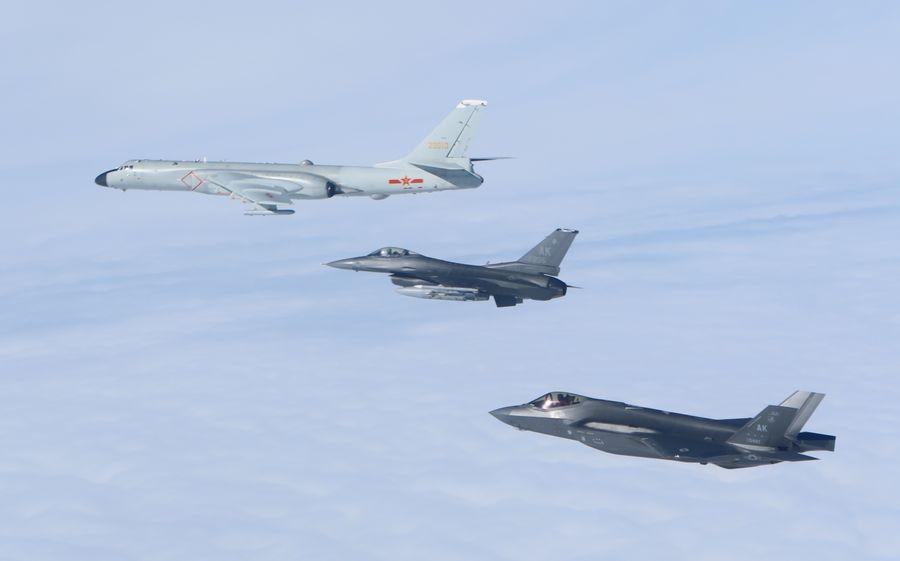
Start with geography. Canada’s defining strategic reality is its proximity to the United States, and that proximity structures almost everything else. The longest undefended border in the world isn’t just a diplomatic achievement — it’s the foundation of a continental security system that neither country gets to renegotiate at will. NORAD isn’t a framework Ottawa revisits every few years according to strategic fashion. It’s how North America is defended. As the Arctic shifts from peripheral to contested, that logic gets more demanding, not less. The polar approach routes that once seemed remote are now a live operational concern, with Russian bomber patrols and Chinese research vessels making arguments that no position paper can. The geometry of those routes compresses time and distance in ways that make independent defence of the northern approaches not achievable without U.S. sensor and intercept support.
Economics reinforce the same constraint. Carney would argue the goal isn’t decoupling from the United States but reducing marginal dependence — a more modest claim, and a defensible one. The defence-industrial base, however, doesn’t accommodate marginal adjustments. Canada’s economy is deeply integrated with the United States through trade, energy, supply chains, and procurement networks that have grown up on both sides of the border over decades. Bilateral trade runs to roughly $720 billion annually, more than double Canada’s trade with the rest of the world combined. Shifting defence procurement outside that base wouldn’t trim dependence at the edges; it would introduce interoperability fractures at the precise points where the alliance is most operationally demanding. The F-35 review shows what this looks like in practice. Ottawa signed a $19 billion contract for 88 aircraft in January 2023, then Carney put the full buy under review a year later, citing concerns about dependence on the U.S. defence industry. The review has since missed every self-imposed deadline, with European alternatives — the Gripen, the Rafale, the Typhoon — still on the table as of late April. RCAF officials have consistently backed the F-35 as the only platform that meets Canada’s operational requirements, specifically for sensor fusion and real-time data sharing within NORAD’s integrated architecture — capabilities that don’t transfer to competing jets. In public statements and congressional testimony, U.S. officials have said that shelving the F-35 deal would put Canada’s standing in NORAD at risk. What the review signals in Washington isn’t strategic autonomy. It’s the kind of hedging that forces American planners to treat an ally as a variable rather than a constant.
There’s a tendency in Ottawa to describe Canada as “aligned” with the United States, as though alignment were a posture that could be periodically adjusted. What Canada actually has is closer to integration. Canadian and American officers plan together through NORAD’s joint command structure. Early warning data is shared in real time. Air defence is built as common architecture, not parallel systems. Procurement decisions on one side of the border shape capabilities on the other. When Canada delayed its fighter replacement for over a decade, the consequences showed up in NORAD planning rooms long before they appeared in budget documents. Both variable geometry and the middle power tradition it updated depend on space — room to broker, hedge, balance — that Canada’s actual position doesn’t provide.
Canada’s March spending announcements are real. The $32 billion for northern bases will produce capability. Reaching 2% of GDP on defence — announced March 26, and the highest level relative to the size of the economy since the Cold War — is genuine progress. But commitments and fielded capabilities are different things. The Victoria-class submarines, acquired secondhand from Britain in the late 1990s, can barely keep one boat operational. Seventy-two of the 88 contracted F-35s remain in limbo. The money is appropriated; the kit doesn’t exist.
Washington has noticed. Every shortfall in Canadian Arctic surveillance or air defence becomes an American planning problem, and American officials are now saying so openly. Canada’s underinvestment is a recurring subject in Washington defence circles. The argument for Canadian capability isn’t only about Canadian sovereignty — it’s about not asking the United States to underwrite a continental defence relationship that Canada won’t fully fund.
Ottawa can keep describing Canada as a swing state capable of diversifying away from American dependence. Or it can deal honestly with the position it actually occupies. The geography hasn’t changed since Trump was elected. And it never will.
Andrew Latham, Ph.D., a tenured professor at Macalester College in Saint Paul, Minnesota. He is also a Senior Washington Fellow with the Institute for Peace and Diplomacy in Ottawa and a non-resident fellow with Defense Priorities, a think tank in Washington, D.C.

End the Jones Act Waiver
By Mark H. Buzby • RealClearDefense
Prediction Markets Are Becoming a New Frontline for Military Operational Security
By Yang Yunke • RealClearDefense
Can Robots Bring Maneuver Warfare Back?
By Ayeza Areej • RealClearDefense
Buy Smarter, Fly More
By Jeff Kojac • RealClearDefense
Stop Gutting the Conventional Army
By R.D. Hooker, Jr. • RealClearDefense
Hung Cao Facing Contentious Confirmation To Become Navy Secretary
By Konstantin Toropin • Associated Press
U.S. Marines Expand M27 Rifle Contract
By Inder Singh Bisht
Kadena AFB Gets First F-15EX Eagle IIs
By Emily Ryan Miller, Defence BlogHung Cao Facing Contentious Confirmation To Become Navy Secretary
By AP
Fair Winds, Peacoat and Desert Camo: Navy Makes Big Changes to Seabag
By MTimes