
How to Use Nuclear Strategy to Save Ukraine
Published March 30, 2022 • Read time: 10m
Western politicians suffer from an egregious ignorance and unfounded fear of the mechanics of nuclear deterrence, which is dangerous because it is the basis for the security of democratic society. Democratic citizens reject investing in large armies, and outside of the United States, in expensive air forces and navies also. Since 1995, non-U.S. NATO has reduced its tank, combat aircraft, and naval ship inventories by over a third. The inexpensive security provided by nuclear weapons won the Cold War for the West and preserved the unprecedented period of the "long peace" (1945-2022), during which there were no major power wars. It creates stability for international commerce, and defines the very structure of the international system, including the five permanent members of the United Nations Security Council, who continue to be the only states equipped to mass-produce thermonuclear weapons. The U.S. Pentagon spends only ten percent of its defense budget on nuclear weapons, with the average city-busting warhead costing approximately U.S.$3 million. Yet, nuclear weapons constitute 99.9% of the world’s military firepower in equivalent megatonnage, rendering artillery, tanks, and aircraft carriers, mere theatre puppets without their own attendant tactical nuclear weapons.
Russian President Vladimir Putin’s threat to use nuclear weapons immediately and irrationally froze Western contemplation of intervention in Ukraine, demonstrating Western politicians' risk-adversity and general apprehensiveness to advance the principles of self-determination and democracy. Their failure to appreciate the resoluteness of a defense that relies on nuclear weapons is partly because of their unimaginable destructiveness that most people would rather not be conscious of on a daily basis. Nevertheless, U.S., French, and English nuclear weaponeers are a military elite, aware of the consequences of their actions, but constantly and professionally ready to execute a retaliatory yet proportional punishment against the cities of the enemies of democracy. A nuclear strike against a Western population center will result in guaranteed retaliatory destruction of a city in the East within as little as 900 seconds.
The biggest mistake democratic leaders make is insinuating that nuclear weapons are “unusable." When nuclear weapons cannot conceivably be ordered to be launched, they lose their deterrent value, and the possessors of these weapons expose themselves to blackmail and exploitation. If Putin can wield nuclear threats to exclude NATO from Ukraine. In that case, he can just as well make any territorial or other demands and threaten nuclear punishment for noncompliance: retaliation for deployment of U.S. forces to Europe, or even retaliation for overflight of satellites. There is no limit to what a timid leader would concede when threatened. This is why Adolf Hitler called the British and French leaders "worms" for their peace-at-any-cost submission to his obvious bluffs, which even he found irrational. Hitler had fully expected to have to invade Czechoslovakia rather than have it surrendered to him. Openly fearing nuclear war betrays a lack of Western self-confidence in its principal instrument of defense.
The lesson of history is that loudly demonstrating deterrence always preserved the peace, and its absence permitted aggressors opportunities for attacks. The British failure to warn the Wilhelmine Germans directly against their entry into Belgium in 1914, was a key cause of the First World War. Failed U.S. threats against North Korea facilitated the Korean War in 1950, just as failed Chinese threats led to the U.S. advance to the Yalu River, and the subsequent intervention by Beijing. India's failure to publicly threaten retaliation was a decisive factor in Pakistan’s 1965 decision to invade Kashmir. The idea that vocal and explicit deterrence somehow causes arms races that cause tensions that cause war has no historical example.
We have been thinking strategically about nuclear weapons since H.G. Wells described a nuclear war in his 1913 book: The World Set Free. Strategic nuclear deterrence is very robust because of the threat of enormous costs when densely populated and industrialized urban areas are destroyed. Naval historian Bernard Brodie (The Absolute Weapon - 1946) argued that the probability, rather than the certainty of nuclear destruction, would make deterrence against war robust. The fact that there is no practical defense against a large-scale nuclear attack, and hidden second-strike arsenals make surprise first strikes irrelevant reinforces that robustness. Congressional staffer William Borden (There Will be No Time - 1946) argued that cities would be attacked last, not first, since they were the easiest targets. Napoleon shelled Vienna to coerce the Austrians to peace after, and not before, his victory at the 1809 Battle of Wagram.
The reluctance of Western leaders to embrace an assertive nuclear strategy is based on two common and oft-repeated assertions. First, that the detonation of a nuclear weapon will escalate, and two, Putin is irrational and therefore cannot be deterred. There is nothing inevitable about a war escalating to a strategic nuclear exchange on the first point. The countless wars between nuclear and non-nuclear powers during the Cold War attests to that in Korea, Vietnam, Egypt, Syria, the Falklands, Lebanon, Angola, Mozambique, Kuwait, Iraq, Afghanistan, Georgia, and now Ukraine. The very limited military escalation of nuclear-on-nuclear power confrontations between the U.S. and the Soviet Union in 1962, China and the Soviet Union in 1969, and between India and Pakistan over Kargil in 1999, reinforces the point. The reason is that the use of nuclear weapons would not occur in a vacuum, but within the context of the balance of power within the international system. If Russia were to use nuclear weapons, states near its borders, such as China, Turkey, Japan, Iran, and Germany, would all develop nuclear weapons, complicating and worsening Russia's security. The state that demonstrates the willingness to use nuclear weapons offensively, will alienate neutrals and its allies, and provoke an arms race with their adversaries.
This does not mean that tactical nuclear weapons will never be used, as these systems are effective analogs of much smaller conventional weapons. Civilian politicians wrongly imagine an instant path of escalation from a single warhead to the wholesale destruction of cities. In fact, the path is extremely attenuated, and it is not conceptually clear why it is inevitable or even likely. The difference in explosive power between a jeep-mounted 0.1-1 kiloton W54 Davy Crocket warhead, launched from a recoilless rifle by a 3-man team, is 1/10,000th of the warhead yield of a standard city-busting warhead, and 1/1,000,000th of the warhead yield of the largest bomb ever constructed, the 100-megaton Soviet Tsar Bomba. Nuclear weapons are tactically versatile. During the Cold War, half of all nuclear weapons were for tactical nuclear warfare at sea, on land, and in the air, and virtually every artillery shell, missile warhead, and torpedo has a nuclear equivalent. A small-scale tactical nuclear exchange, perhaps an exchange of one, or five, or twenty warheads in Ukraine, will have little effect on civilization, or even Ukraine. There was no detectable radiation at either Hiroshima or Nagasaki within ten years of the blast, and the cities were rebuilt into prosperous industrial hubs very quickly. The Soviet Union tested 456 nuclear devices at Semipalatinsk, Kazakhstan, and the U.S. detonated 928 warheads, including 100 above ground, at their Nevada test facility, all with negligible environmental impact. I drove to within 40 km of the site with my wife and kids, right up to the fence and its sign restricting photography. The mountains and brush did not seem to notice the unprecedented bombardment.
On the second point, of the impossibility of deterring an irrational leader, there is no evidence of Putin's insensitivity to the costs of nuclear war, given his multiple families, political dependents, and wealth. If he were genuinely irrational, he would already have used nuclear weapons: what better way to secure Ukraine without foreign interference? During the First World War, the threat of mutual retaliation deterred the use of gas on cities, despite the alleged enthusiastic militarism of German Kaiser Wilhelm. During the Second World War, Hitler had every incentive at the very beginning, during the stalemated years, and desperately at the very end, to use Germany's very large arsenal of battlefield nerve gasses. But Adolf Hitler, the archetype of the ascetic and eschatological totalitarian warrior, did not. Besides, all of the evidence is that self-destructive leaders tend to be sidelined or betrayed by those in their hierarchy. Unlike other weapons, the sheer destructiveness of nuclear weapons has a "crystal ball" effect, in which leaders very easily imagine its consequences, and their reluctant subordinates. Hitler's planned demolition of Germany in 1945, Operation Gotterdammerung, failed due to the noncompliance of his generals. During the 1991 coup in Moscow, the Russian general staff removed the Kazbek terminal that controlled the launch of nuclear missiles from any of the embattled political opponents, including Mikhail Gorbachev.
Rather, Putin’s “madman” nuclear threats count on Western leaders' fear of opening Pandora's Box and equating the use of a single tactical nuclear detonation as the end of civilization. There will certainly be horrible externalities, like an acceleration of nuclear proliferation, particularly by rogue and insecure states, and the shock of the normalization of nuclear war. However, a greater disaster would be for the democratic form of government to be a temporary historical innovation, and doomed by its defensive inefficiency, to extinction. There is nothing inevitable about the spread of democracy: the self-governing Italian city states of the late middle ages, like Florence, Pisa and Genoa, had by the early modern period all succumbed to the authoritarian rule of ruthless princes, like Lorenzo the Magnificent of the Medici, or were conquered. This outcome is more properly equated with the end of civilization.
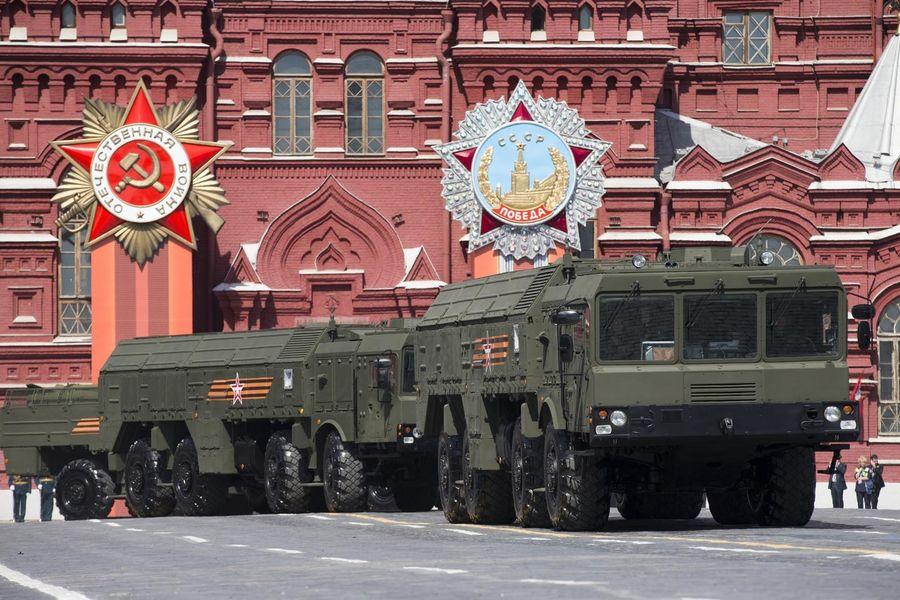
During the early Cold War, the U.S. designed Pentomic Divisions, organized for dispersal against nuclear strikes, though these were irresponsibly abandoned during the mid-Cold War with the onset of the Vietnam War. Therefore, using nuclear weapons to create a deterrent umbrella over a Western force is straightforward. Ground units, which create political facts on the ground by being able to seize and control the use of territory, would be equipped with tactical and theatre nuclear weapons, and would advance into Western Ukraine, in a dispersed fashion to reduce the impact of a nuclear attack. These ground forces would constitute ninety percent Polish, Slovak, Hungarian and Romanian units, bolstered by ten percent British, French, German, and U.S. ground forces. The media would be invited to observe the presence of a variety of nuclear weapons at the moment of intervention. Russia could immediately resort to the use of nuclear weapons, striking at these units, but would then have its own forces, much less dispersed and controlled, immediately struck. These Western forces would have “escalation dominance” in the sense that if one extrapolated escalation across time, at the end of the escalation, Russia would never achieve an advantage, and would be left with the realization of a default and automatic retaliatory response.
Dr. Julian Spencer-Churchill is an associate professor of international relations at Concordia University (Montreal), former army engineer officer, and has written extensively on Pakistan, where he conducted field research for over ten years.
End the Jones Act Waiver
By Mark H. Buzby • RealClearDefense
Prediction Markets Are Becoming a New Frontline for Military Operational Security
By Yang Yunke • RealClearDefense
Can Robots Bring Maneuver Warfare Back?
By Ayeza Areej • RealClearDefense
Buy Smarter, Fly More
By Jeff Kojac • RealClearDefense
Stop Gutting the Conventional Army
By R.D. Hooker, Jr. • RealClearDefense
Hung Cao Facing Contentious Confirmation To Become Navy Secretary
By Konstantin Toropin • Associated Press
U.S. Marines Expand M27 Rifle Contract
By Inder Singh Bisht
Kadena AFB Gets First F-15EX Eagle IIs
By Emily Ryan Miller, Defence BlogHung Cao Facing Contentious Confirmation To Become Navy Secretary
By AP
Fair Winds, Peacoat and Desert Camo: Navy Makes Big Changes to Seabag
By MTimes