
In Biden Support for NATO, Budget Must Back Words
Last updated 06:40 AM EDT • Read time: 4m
This has been an important month for the relationship between the United States and its NATO allies. President Joe Biden began his trip to Europe with a visit to British soil, where he said, “America is better positioned to advance our national security and our economic prosperity when we bring together like-minded nations to stand with us.”
The president went on to praise America’s “unrivaled network” of alliances and partnerships as having made the world “safer for all of us.”
Notably, he said the United States and its allies would face our challenges “from a position of strength.”
At NATO headquarters in Brussels, the president made clear that America's commitment to the NATO Alliance is "critically important for U.S. interests" and called it "a sacred obligation."
As the former NATO Commander, I am heartened greatly by the president’s articulate commitment to the alliance. He’s right: Only NATO can deter Russian aggression and assure freedom-loving nations in Europe their territorial integrity.
For well over a decade, Russia under Vladimir Putin has been increasingly belligerent, waging some form of war on its smaller neighbors almost constantly - from the war with Georgia in 2008 to the annexation of Crimea in 2014, to the ongoing proxy war in Ukraine that continues to this present day.
Earlier this year, Putin made a threatening show of force along the border with Ukraine. Some of the forces amassed have returned home, . . . but notably most of their military equipment remains positioned on the border, making a lightning strike more feasible.
In recent months, unusually high numbers of Russian military aircraft have buzzed allied airspace, forcing NATO forces to scramble jets to intercept them. Russian missile and submarine exercises have proliferated.
The Baltic States of Lithuania, Latvia and Estonia, NATO members once occupied by the Soviet Union, are especially vulnerable.
In response, NATO has been stepping up its own exercises to create the kind of muscle memory that allows for a more rapid, cohesive and coherent response to aggression while at the same time reassuring our allies, especially those that border Russia.
For the Baltic States and Poland, NATO has deployed a rotation of four multinational battalion-sized battlegroups. NATO’s Baltic Air Policing effort has been intercepting Russian air incursions on an ongoing basis; today’s rotation features Italian F-35s intercepting Russian aircraft.
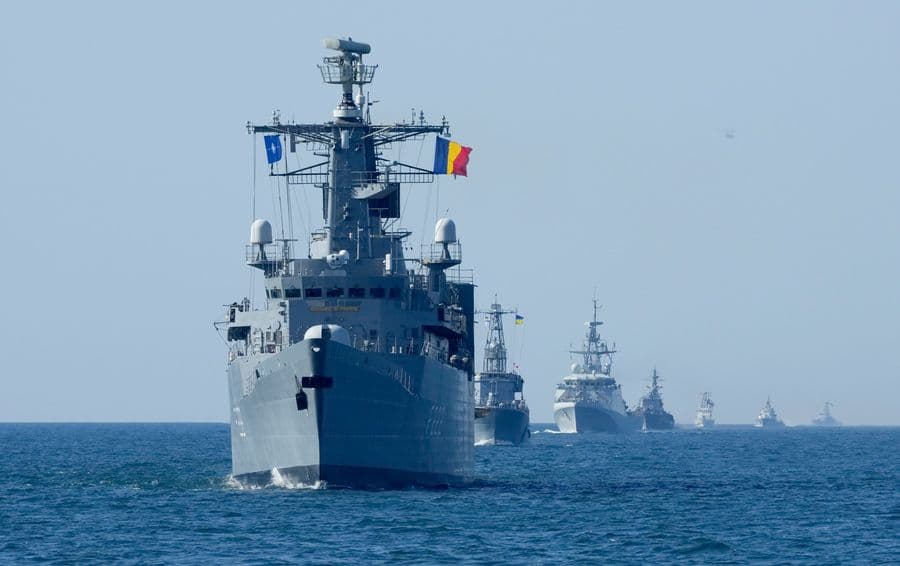
At sea, the deployment of U.S. Marine Corps vertical-takeoff-and-landing F-35Bs on the U.K.'s HMS Queen Elizabeth aircraft carrier, escorted by a multinational flotilla, is a standout example of unprecedented cooperation and interoperability within NATO. The carrier battlegroup has just completed exercises with the French carrier Charles de Gaulle in the Mediterranean.
All this is welcome and positive, but effective deterrence is hollow without sufficient funding, focused on the right priorities. On this count, our rhetoric about the commitment to NATO and operating from a position of strength is writing checks that the current U.S. defense budget can’t cash.
Take, for example, the F-35. There is no question that the F-35 strengthens NATO's air power vis a vis Russia. It's one of the few platforms coming online in sufficient numbers that the Russians are genuinely concerned about countering. NATO Commander Gen. Tod Wolters once compared Russian engagement with the aircraft to “jump[ing] into a boxing ring and fight[ing] an invisible Muhammad Ali.”
The platform is a natural for enhancing partnerships due to its interoperability. Gen. Wolters has praised the aircraft’s “tremendous capability” and has said there will be 450 F-35s stationed in Europe.
But that won’t be until 2030.
That goal is going to be a struggle if we don’t start buying those aircraft at a faster rate. Small fleets drive up both the cost of sustainment and have serious impacts on readiness and deterrence.
Yes, some hard choices have to be made. Legacy platforms – fourth-generation aircraft designed in the midst of the Cold War - need to be retired. And we can’t pit our research and development funding – needed to maintain tomorrow’s edge - against the immediate procurement needs we have today. We must have both.
Our Joint Force needs weapons platforms with next-generation capability, like the F-35, on the battlefield today.
Deferring procurement of the most capable platforms available shortchanges our deterrent posture and puts the president’s words about the value of NATO and operating from a position of strength at risk.
The president’s support for NATO and our allies has set the right tone. America must put our money where our mouth is – to demonstrate our allied commitment and to ensure an effective deterrent.
Gen. Philip Breedlove (U.S. Air Force, Ret.) served 39 years in the U.S. Air Force, during which he served as NATO’s 17th Supreme Allied Commander Europe, commanded U.S. European Command, and served as the 32nd vice chief of staff of the Air Force.

Eight Months of Epic Fury and Still No Internal Alternative
By Stephen D. Cook • RealClearDefense
The Readiness Cliff: Pacific Lessons Drawn from the Middle East
By Brian McSorley • RealClearDefense
The Pentagon’s Real Modernization Problem Is Time, Not Technology
By Bruce Allen Lubbering • RealClearDefense
The World His Mother Opened
By Carlo J.V. Caro • RealClearDefense
Wake Island Lessons for Expeditionary Advanced Base Operations
By Brian J. Dunn • RealClearDefense
Wake Island Lessons for Expeditionary Advanced Base Operations
By Brian J. Dunn • RealClearDefense
U.S. Navy Expands Unmanned Mine Hunting
By Global Defense News
MRF-SEA Will Maintain Continuous Presence in the Philippines
By Mahadzir, USNI News
Space Force Weighs Proliferated Cislunar Satellite Constellation
By C. Albon, A&SF
America-Class Amphibs Enable New Ship-to-Shore Attack Strategies
By Warrior M.