
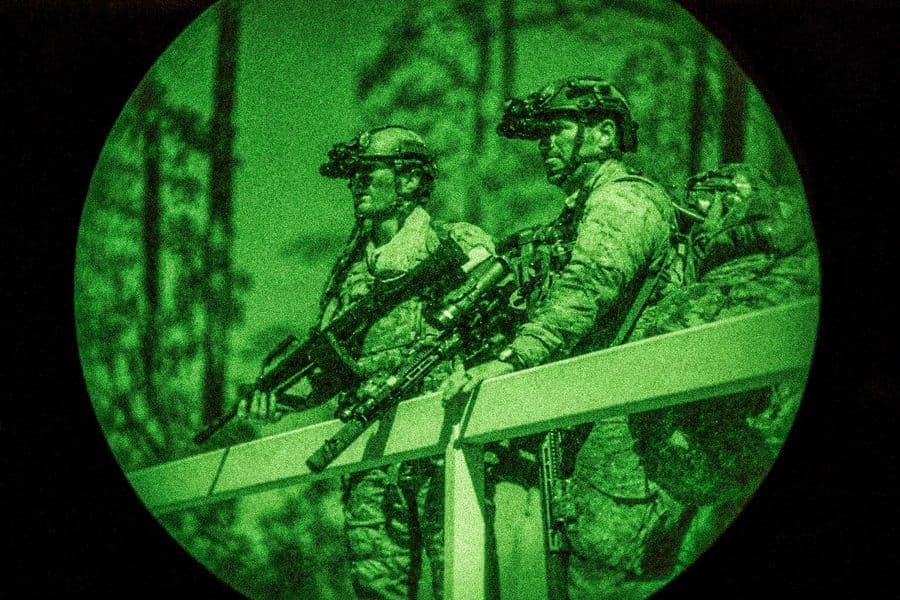
U.S. Green Berets assigned to 3rd Special Forces Group (Airborne) provide security from the bed of a Light Medium Tactical Vehicle during preparing for a medical extraction while executing a full mission profile as part of exercise War Horse near Fort Bragg, North Carolina, Oct. 21, 2026. War Horse is a baseline lethality exercise, designed to enhance readiness and develop combat skills through realistic scenarios, reinforcing the decision-making, adaptability and lethality required to operate in complex operational environments. The exercise integrates and evaluates 22 individual and collective baseline tasks to ensure Green Berets are prepared to operate independently in austere, hostile and politically sensitive environments. (U.S. Army photo by Spc. Seu Chan)
The Drinking Well: The Army Should Train Leaders to Make Decisions Under Pressure
Last updated 06:28 AM EST • Read time: 5m
During the third round of an eight-round professional fight, the nerves branching out from my neck that control my right arm gave out. A neuropraxia of my right brachial plexus left that arm hanging like it weighed a thousand pounds. My fingers were too heavy inside the glove to close into a fist. In my head, I watched what came next: getting beaten with no way to defend myself, dropping to a knee, telling the referee I could not continue.
Then I accessed my mammalian brain and processed. My legs worked. I was in shape. I could still think, and I had one good arm. I am a West Point graduate. He still had to beat me.
I boxed the next five and a half rounds with my nondominant hand. I picked my moments, processed information, and won. That round taught me the ring’s best lesson. It is not toughness. It is how to optimize decision-making while fear is attempting a hostile takeover.
The Army should train that capacity more deliberately through carefully controlled, pressure-based exercises, followed by structured reviews of the decisions made under stress.
Picture a well full of water. Every time you exercise self-control, you drink from it. Every time you make a decision, you drink from that same well. Anxiety drinks from it too, and it drinks before both. Stress, fear, and dread can begin taking their sips before you have made a single choice. When the moment arrives for a consequential decision, the water level may already be lower than you realize.
Psychologists have investigated this idea through the strength model of self-control. Within this model, my well is a metaphor, not a literal reservoir. Still, it offers a practical question for leaders: what happens to our judgment when anxiety has already occupied our attention?
When my right arm stopped working, fear had already written my surrender. However, training helped me recognize what remained available instead of surrendering to what I had lost.
My Harvard master’s research examined boxing-training sparring and self-control. Years of sparring were positively correlated with a six-item sparring-specific measure (r = .541, p = .001). It raised a question I believe deserves testing: can repeated practice making decisions under pressure improve how leaders respond when their plans collapse?
There is another trap for disciplined leaders. I call it the shaken soda can. Every provocation shakes it. Every swallowed frustration, sleepless night, and difficult conversation shakes it. Emotional carbonation builds. The person who shakes the can one additional time may receive the force of every shake that came before. In a military unit, that person might be a junior soldier asking an ordinary question. Leaders must recognize the warning signs before pressure becomes a disproportionate reaction.
Boxing teaches another response. Between rounds, the bell gives a fighter a minute to breathe, listen, and reassess. But a boxer cannot always wait for the bell. Sometimes we clinch: we tie up an opponent, temporarily stopping the exchange. We give up the opportunity to punch so we can prevent further damage or regain control.
A leader needs to operationalize a clinch. In garrison, that might mean pausing a heated conversation, taking a walk, and returning when both people can engage deliberately. It might mean reminding someone of the mission’s desired end state before resuming a disagreement. The return is essential. A clinch is not an excuse to avoid accountability.
I spent three years teaching Intermediate Level Education to Army majors. In a classroom, leaders can explain emotional regulation, ethical restraint, and sound judgment. But knowing the correct answer while seated is different from selecting it when frightened, fatigued, or provoked.
I would begin with selected combatives or other pressure-based activities that require meaningful choices without unnecessary injury risk. Controlled contact, trained supervision, medical safeguards, and clear stopping criteria must be nonnegotiable. The purpose is not to see who can endure the most punishment. It is to examine whether a leader can recognize stress, process information, select a response, and exercise restraint.
Record exercises. Review decisions sequence by sequence. Ask what the participant noticed, what emotion was present, what options remained, and why a particular action followed. Develop a scoring system and test whether improvements transfer beyond the exercise. A soldier who stops an unsafe drill may be demonstrating precisely the judgment we want.
We already train soldiers to function when their bodies are tired. We should train leaders to recognize when their minds are being challenged. Teach them to recognize when the well is low, when the soda can has been shaken, and when to create their own bell before the next consequential decision.
Boyd Melson is a Lieutenant Colonel in the U.S. Army Reserve, a Public Affairs Officer, a West Point graduate, and a veteran of Operation Inherent Resolve. He holds a Master of Business Administration from Touro University International, a Master of Liberal Arts in Psychology from Harvard University and is a doctoral candidate in Organizational Change and Leadership at the University of Southern California. Melson is a former U.S. Olympic Boxing Team Alternate, 2005 Team USA Men’s World Boxing Team Captain, World Military Boxing Champion, and WBC USNBC Super Welterweight Champion. He also serves as a WBC Ambassador to the Military. His military service, elite boxing career, and academic research inform his perspective on leadership, self-control, and decision-making under pressure.
The views expressed are his own and do not necessarily reflect those of the U.S. Army or Department of Defense.

Eight Months of Epic Fury and Still No Internal Alternative
By Stephen D. Cook • RealClearDefense
The Readiness Cliff: Pacific Lessons Drawn from the Middle East
By Brian McSorley • RealClearDefense
The Pentagon’s Real Modernization Problem Is Time, Not Technology
By Bruce Allen Lubbering • RealClearDefense
The World His Mother Opened
By Carlo J.V. Caro • RealClearDefense
Wake Island Lessons for Expeditionary Advanced Base Operations
By Brian J. Dunn • RealClearDefense
Wake Island Lessons for Expeditionary Advanced Base Operations
By Brian J. Dunn • RealClearDefense
U.S. Navy Expands Unmanned Mine Hunting
By Global Defense News
MRF-SEA Will Maintain Continuous Presence in the Philippines
By Mahadzir, USNI News
Space Force Weighs Proliferated Cislunar Satellite Constellation
By C. Albon, A&SF
America-Class Amphibs Enable New Ship-to-Shore Attack Strategies
By Warrior M.