
Values and Vaccination: The Potential Cost of Culling the Herd
Last updated 05:20 AM EST • Read time: 5m
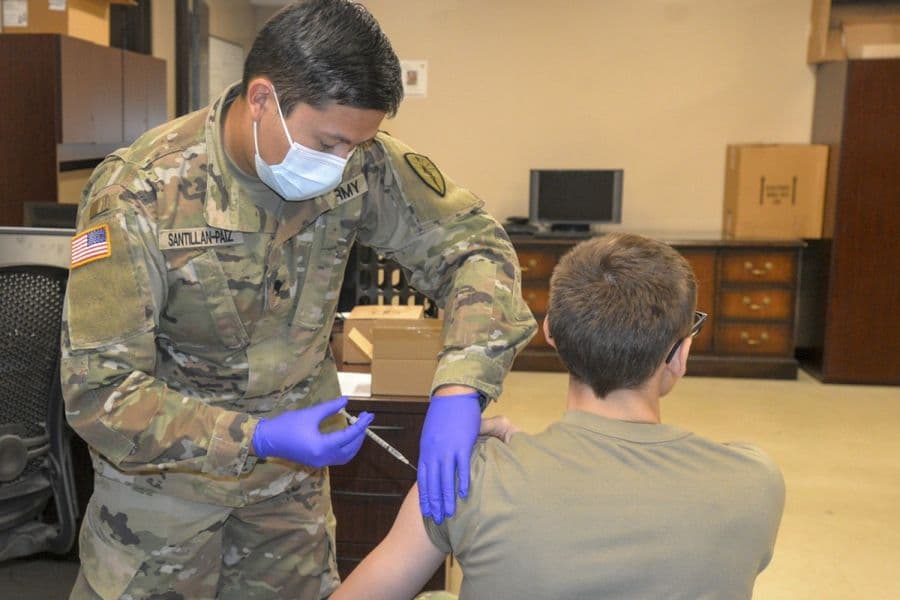
Since the professionalization of the Army after the Vietnam War, the Army has worked hard to instill a set of values in the force. It has aimed to create a culture of doing the right thing. In 1995, this was codified in AR 600-100 as the Army Values. Since then, Loyalty, Duty, Respect, Selfless Service, Honor, Integrity, and Personal Courage have been inculcated in every person recruited. These values have been emphasized and reinforced by leaders at all levels.
However, as useful as the Army Values are for maintaining morality and strength of character in the force, they can be a double-edged sword for senior leadership. As the recent resistance to the COVID-19 vaccine has demonstrated, sometimes soldiers’ values conflict with Army policy. What then is the Army to do in such a situation? Culling the opponents of the vaccine is an option, of course, but then the Army risks eliminating many of those who most embody integrity, honor, and moral courage, which could have significant impacts on the force in the future. The Army needs to carefully consider how it handles the current ethical dispute surrounding the COVID vaccine, or it risks thinning the ranks of the very people it relies on to police a wide variety of undesirable acts, from sexual harassment to racism to war crimes.
Moral courage is defined as “facing fear, danger, or adversity (physical or moral)” and “continuing forward on the right path, especially if taking those actions is not popular with others.” Whatever one thinks of the ethics involved in the production, testing, or mandatory distribution of the COVID vaccine, it certainly takes moral courage on the part of a soldier to resist a direct order to take it. Discharging a large number of people willing to risk their careers, professional reputations, and fiscal security over an issue they feel strongly about might have unforeseen consequences during the Army's next war. Not only will the discharged personnel themselves not be there, but the remaining soldiers will have witnessed a powerful lesson in the potential costs of speaking truth to power and standing up for one’s beliefs. The next time a bad cultural paradigm allows something like the Mỹ Lai massacre to occur, will there be a Hugh Thompson there to stop it?
Culling people of honor and integrity is similarly risky. Integrity is "doing what's right, legally and morally. . . A quality you develop by adhering to moral principles.” Honor is defined even more simply as “living the Army values" in everything you do. A significant number of those who object to receiving the COVID vaccine are doing so for religious reasons. They believe strongly enough in their chosen moral principles to risk substantial personal harm (from both the disease and professional repercussions) to refuse the vaccination. While a process exists to exempt these soldiers from the vaccine for religious reasons, to date, the Army has approved zero religious exemptions to the COVID vaccine, so it seems likely these personnel will also be discharged with the soldiers who morally disagree with the vaccine for non-religious reasons. What effect will their discharge have on the force? In our next war, will the soldiers and leaders most prone to prevent future incidents like the torture at Abu Ghraib be present, and if they are, will they be willing to stand up to the cultural pressure to go along with something they think is morally wrong?
None of the above suggests that courage, integrity, or honor are limited to those who refuse the COVID vaccine. People's values stem from a wide variety of foundational beliefs, and for many people, the vaccine is simply not an ethical issue. However, for many soldiers, it is an ethical issue and based on the number of current hold-outs (4% of the active duty force – 14,447 soldiers - as of today), a large number of these may be throwing their boots over their local power lines in the near future. Will the Army be better or worse off than it is today when they do so? Will the absence of these dissenting voices, strong believers and independent thinkers, make the Army's attempts to avoid taking the Bus to Abilene (or perhaps, more accurately, the bus to Abu Ghraib) more or less successful? And perhaps most importantly, when these soldiers are gone, will the Army be more or less ready for our nation's next conflict? Before taking any rash action, the Army should consider all of these questions carefully to ensure that today’s politically expedient solution does not undermine long-term readiness and moral courage in the force.
LTC Daniel Pace is an active duty Special Forces officer. He has deployed to countries across the Middle East, Latin America, and Africa, and he currently lives with his family in Germany.
The views expressed in this article are the author's own and do not represent the Department of Defense.
From Siberia to Fairford: How Operation Spider’s Web Has Changed the Rules of Airpower
By Frank A. Rose • RealClearDefense
Faster Simulations, Better Defense Decisions
By Rut Lineswala • RealClearDefense
Will HASC Have an Oversight Subcommittee in the Next Congress?
By Christopher J. Bright • RealClearDefense
The U.S. is Overpaying for Missiles
By Alex Lee • RealClearDefense
The U.S. Nuclear Deterrent Umbrella
By Peter Huessy • RealClearDefense
From Siberia to Fairford: How Operation Spider’s Web Has Changed the Rules of Airpower
By Frank A. Rose • RealClearDefenseFaster Simulations, Better Defense Decisions
By Rut Lineswala • RealClearDefense
Bombers Could Have a Major Air-to-Air Combat Role
By Joseph Trevithick, The WarZone
Pentagon, Lockheed Agree to 10-Year Deal for 850 F-35 Jets
By M. Scanlon, Military T.
The Marine Corps Has a Boot Problem
By Travis Pike, Sandboxx News