
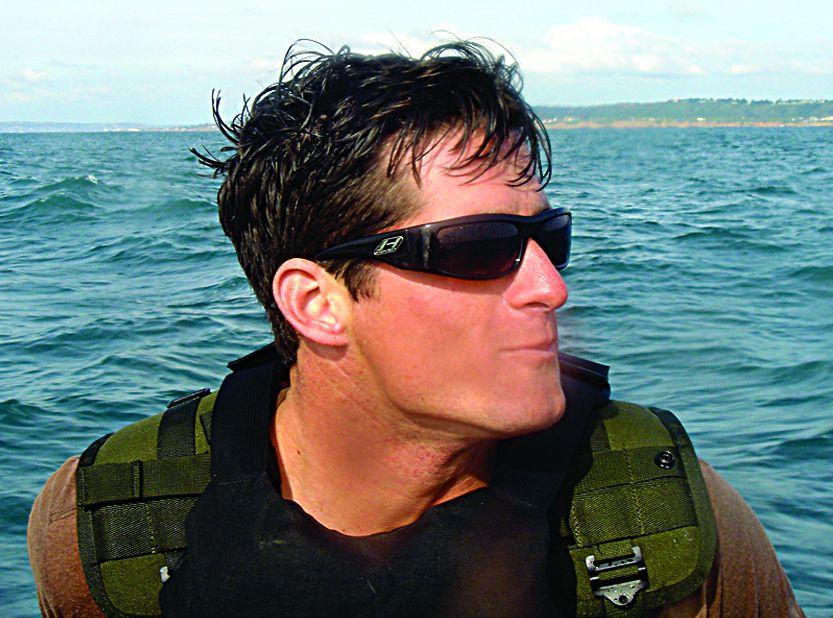
A Father's Gold Star Story
Published Jan. 14, 2023 • Read time: 19m
Michael Monsoor deployed to Al Anbar Province in the spring of 2006. He was serving as a Navy SEAL during the Battle of Ramadi, training the Iraqi Army and fighting alongside American soldiers and Marines for control of the city.
During a firefight on May 9, 2006, Michael ran into a street to rescue a wounded teammate, exposing himself to a high volume of enemy gun fire from multiple positions. His teammate survived the wounds and Michael was later awarded the Silver Star for heroism.
Four months later, on September 29, 2006, Michael and three SEAL teammates had taken an overwatch position on a rooftop in Ramadi. It was the final days of their deployment. When an enemy grenade sailed over the wall and hit Michael in the chest, he looked at a teammate then covered the grenade with his body. The blast killed him but his actions saved the lives of his teammates. He was selected to receive the Medal of Honor for combat bravery in 2008.
In Defend Us in Battle: The True Story of MA2 Navy SEAL Medal of Honor Recipient Michael A. Monsoor (Harper, 2022), Michael’s father George Monsoor and writer Rose Rea draw on interviews, military records and eyewitness accounts to tell Michael’s story. The book is compact and compelling. What shines through most is a father’s love for his son. Beyond the incredible acts of heroism in combat and the ultimate sacrifice made for his teammates, Michael comes across as a real person, a good person.
“He was good,” George told me. “It’s a simple word. But it’s so hard to be good.”
South Korea’s Nuclear-Powered Submarines After the Midterms
Why Build a Billion-Dollar Warship if a Cheap Drone Can Sink It?
Hung Cao Facing Contentious Confirmation To Become Navy Secretary
How Digital Twins Can Strengthen Naval Readiness Before a Crisis Begins
What follows is my conversation with George Monsoor on family, patriotism and the void that can never be filled.
You named your son after Saint Michael the Archangel. “It was a perfect fit,” you wrote. Why did you give your son this name?
I had reasons for naming all the boys and he was going to be Michael. Joseph and James are my other two boys. But Michael just had problems early on, there were some difficulties during the pregnancy. I wasn’t religious at all when I was younger but life has brought me back to believing in God. I wanted that to be a part of their lives when they were young. And I thought of Michael as being strong, not just a military warrior. Life is hard and you have to be strong, you have to stand for something.
Military roots run deep in your family. You were a Marine and Michael’s brothers served in the Marine Corps. I take it your family flies the American flag?
Oh, of course. People send me flags and I have so many flags already. My father served in the Navy during World War II. My uncles and aunts all served in the military in some capacity as well. Uncles served in Korea. We have always been patriotic, and especially Michael.
But my father suffered a lot. The war hurt him psychologically and I didn’t realize it until he got older and he would have these emotional breakdowns at the VA hospital. The stress of war was what bothered him. I still deal with some of the SEALs and guys I was with in the Marine Corps and there is real damage. They cannot get it out of their head, things they saw and did. Until you’ve seen this happen to people or been raised around it, it’s difficult to understand. My father was happy and fine and suddenly he wasn’t, and so I used to worry about Michael and whether he would be okay when he came back from overseas. Everyone in the family pays for that experience.
You didn’t want him to become a SEAL, is that right?
Well, I was happy that Michael joined the Navy but not the SEALs. They are adventurous and take chances. I never realized it was in his head growing up. And, sure, we teased him about being a SEAL, that he was the black sheep in a family of Marines. Then he brought home all this special gear he got and we were envious of his gear. Marines never got stuff like that.
Though he was small in stature, Michael was “full of energy and exuberance.” He struggled with severe asthma as a boy, but “never quit trying to strengthen his lungs.” Tell me about your son as a little boy.
He had struggles. The asthma was so bad my wife and I would take turns sitting next to him while he was sleeping. There were episodes where we would rush him to the emergency room because he couldn’t get any air, and so we were constantly worried about him. Yes, he was small and weaker than his brothers, a magnet for bullies in a way. He wanted to stand up to the bullies. He was constantly thinking about how to stand up to a world of bullies, which became formative for him.
I remember Michael would sneak into a community pool here where we lived. He would push himself hand-over-hand all the way around the pool, challenging himself to become stronger. He would be the guy climbing on top of our roof, or building little ramps out of wood and then launching his bicycle off the ramps trying to get some air. He would fall off, hit the ground, then get back up. If there was something that made him afraid, then he had to overcome it. During the deployment to Ramadi, Michael was anticipating having to do more skydiving as part of SEAL training when he came home, and he really didn’t like skydiving. But I remember him telling me he wanted to do more skydiving so he could own it, you know, so he could own the fear.
Michael didn’t make it through BUD/S the first time. He developed lesions on his feet. He came home from training and tracked blood on the floor of your house. How did he experience failure?
It was really hard on him. I remember when he came home and he was a miserable mess. There was sand in his wounded feet. I could just see his eyes, tears welling in his eyes, and he was breaking down, telling me that he had to quit. Probably the hardest thing Michael ever did to that point, but I knew for sure that he had done everything he could do. The very next day he told me he was going to do it again. He hated to lose on things like this. If he wanted to do something, he would be determined to try and try again. It was almost like he put on another face.
What lessons did he learn from failure?
I’d say he was ready mentally the first time but he was not quite prepared physically. He recognized the small things he didn’t do right. He simply didn’t take care of his body. He didn’t keep the sand out of his boots, simple stuff. Carrying around those logs and boats—he’d be straining his back or not using his body in the best way. The next time, he kept the sand out of his boots.
Michael was kind of a thinker like that, constantly thinking, even when he was little. If he wanted to get something, he would think and plan it out. I think it was because he was bullied so much that he was constantly thinking about how to get around the bullies or get what he wanted some other way. He was resourceful and always willing to try again.
He leaves Coronado and is transferred to Sigonella, Italy. This seems like a good tour for Michael. Blue skies. Crystal clear water. He buys a Lancia with all-wheel drive and speeds around Sicily. And he’s got good friends, beer and steaks on the grill. He’s getting together with friends to watch American movies like Dazed and Confused. Tell me about that time in Italy.
Oh, Michael was always patriotic and loved America. He had these friends and they would get homesick for America. So, he got these guys together and they’d have barbecues and just come together over some really basic American traditions. It was a club, like Club Americanas or something. Some of the Sicilians thought it was a little strange, but his door was always open to anybody who wanted to come in and enjoy.
And he loved adventure. I remember once he was bragging to his mother that he had this great view of the Mediterranean from his apartment, this incredible panoramic view of the sea. So, my wife takes a trip out there and, sure, if you looked just far enough and craned your neck just the right way, you could just barely catch a glimpse of the water. But that was Michael. He had a way of looking at things in an optimistic way.
Years before, when we moved to Garden Grove, he had some friends who really didn’t have a lot, and he was always giving away the gifts I gave him. I’d see a kid running down the street with stuff I gave Michael for Christmas. He had a way of looking at things in an optimistic way, especially among his friends, and being generous.
When he got to Ramadi, he built his hooch and covered it in this bright orange color. Everything was fine; everything was great. It was easy to spot where he lived—it was bright. He cheered guys up. I’d say we were pretty much that way as a family, but Michael was much more than we were. I was a businessman. We had ups and downs and the family always adjusted. We’d live in a million-dollar neighborhood for a few years during the good times, then times would change and we’d live in a more modest neighborhood. My kids always seemed to adjust. Michael certainly adjusted and kept his positive outlook through good times and bad.
After the tour in Sigonella, Michael returned to BUD/S with class 250. Seventy-five percent of the original number washed out but he remained. He came back and triumphed.
I remember telling him, “Are you sure you want to do this again?” He just looked at me and told me that he was going to finish. We’d taught our kids to never give up, to finish things. But I was willing to advise him against going through the training again. Michael had this huge smirk on his face when he graduated because he knew he proved me wrong. But I was happy when my kids proved me wrong.
He joins a west coast SEAL team and starts his work-up for Iraq. Life in California is good. Michael has a motorcycle and a Corvette, and there are trips mountain-biking and skiing…
Yeah, he’s feeling great. I think he got hooked on speed driving around with me when he was a little kid. I had a ‘64 GTO and I’d go through the gears on that and he’d just love it, smelling the rubber burning. He loved the speed. I kind of wish I hadn’t done that because he loved the exhilaration.
But he was loving his life. Once he and his brother were going skiing. Joe had football practice and Michael had training, so they were both pretty worn out by the weekend, but they’d decided to go skiing up at Mammoth that weekend. They come home and the windows are busted out, mirrors torn off the car. “What happened?” I asked. Well, I guess Joe had been sitting on the passenger side, fell asleep, and all of a sudden there’s tree branches crashing through the car. He looks over at Mike, the driver, and he's sleeping, too. He yells “Mike, Mike!” And Mike wakes up, doesn’t even blink but brings the car back onto the road. I had hardly an idea about all the adventurous stuff he was doing in his spare time.
In 2006, your son deploys to Ramadi, where the U.S. military is performing clearing operations. Thousands of insurgents are located throughout the city. It’s a violent time. Servicemembers are lining up almost weekly to donate blood for the wounded, and Michael is in the thick of it, carrying the Mk 48 machine gun.
Michael wasn’t telling us the truth. He was telling us that he was “dying of boredom” teaching the Iraqi troops how to march. My wife wanted to believe him but we knew it was worse. The media wasn’t covering it very well because of how dangerous the environment had become.
By August 2006, we finally realized how much he was stretching it. We went to attend a funeral of another SEAL. A friend of Michael’s was at the funeral. He told us a story of how Michael had saved his life in a firefight. He said Michael had run out into the street under heavy fire to rescue him, that he just couldn’t believe what Michael had done for him. It’s captured in the book, but this SEAL said he literally saw wings attached to Michael, as if he were an angel saving his life. That’s when we realized Michael was not just teaching Iraqis how to march. We recognized it was very dangerous and things got tense at home.
It was a horrible feeling. You’re always worried, especially when your son is in a very aggressive part of the service. Imagine the stress of young men being in firefights every day. It’s hard on the family, imagining what could be happening. You’re worried. You’re worried that Michael is going to do much more than he had to do because I knew he was that way. When he would call home, he was keeping track of all the guys in his unit, especially the ones with children. It stuck in my head that he knew who had kids and who was married. This guy Michael was just so determined that anybody he goes out with is going to come back. When I dropped him off the day he left for Iraq, I gave him a hug and a kiss on the cheek. But I had this feeling. I told my son Joe at home that I just don’t know if Michael’s going to come home. There’s something there, and I don’t know what it is; it cannot be explained. I didn’t have that feeling with my other boys. I tried to put that feeling away. I tried laughing at myself the later we got into deployment.
You started feeling relief as his deployment neared the end, is that right?
Sure, I felt like I’d been an old lady, constantly worrying. Every time we talked on the phone, I told him to do his job and be careful. He said to me: “Don’t worry; I’ll decide if I die over here.” As a parent, you’re not happy with that decision. When I talked to one of his teammates, he said he definitely made the decision. His teammate looked right at Michael. He saw it in his eyes. Michael was in a position on the roof where he could have gotten away. I don’t understand that. He said he would make that decision, and he did.
September 28, 2006. The day that Michael went out on his final mission, he calls your phone and leaves you a voicemail. “Hey, guys, it’s Mike. Hello? Hello? Mom? Dad? You’ll be sorry you missed me. I’ll catch you later.”
I had the voicemail for years. Somehow it disappeared. I regret missing his call. I went to replay it two or three years ago and it disappeared. But it was a lighthearted message, which was typical. Michael never let stuff get to him and it came through on that phone call. The only time I saw him low or unhappy was when he had to drop out of BUD/S. Every other time, he had this resilience and determination. His voice was always on the sunny side.
September 29, 2006. Michael is on a rooftop. A grenade came over the lip of the rooftop and strikes Michael in the chest. He looks at a teammate, yells “grenade,” then covers the grenade with his body. He died on the feast day of Saint Michael the Archangel.
I think like most people, you’re angry and question your faith. After a while, you start to realize these things are a part of life. Not everyone is going to live a long and beautiful life. There are sacrifices people are going to make. We don’t know enough about this world to understand it. My wife was hurt and disappointed. But we all went back to practicing. There are things you cannot sort out. You cannot just pray and be protected and have it all worked out. There are so many horrible things that happen in this world and no explanation other than this world is a rough place and few people seem to realize it before it’s too late. But Michael took it so seriously protecting his guys. He would carry half the water he should carry because he wanted most of his load to be ammunition.
How did you learn of Michael’s death?
I wasn’t home. I was at work. My son calls me and he couldn’t even get it out. Then my daughter calls me and she tells me that the Navy is at the house with mom. When I got home, my wife just said she heard a knock at the door and, as she approaches the door, she saw these guys in uniform. She was praying that Michael was wounded. She didn’t want to think of the alternative. She said her stomach tightened. She opened the door and her hands were shaking. Just the sight of these guys standing there at the door. She was hoping for something she knew probably was not true. She was crying before she even opened the door.
You mention your wife and how she prayed for her son.
She prayed daily. She was devastated and I remember holding her. She was melting in my arms. She was always so positive, praying and everything. It hurt her. The prayers in her mind were not answered. A mother and a son. My wife is no longer with us, but she worried about Michael ever since he was a child. He was good. It’s a simple word. But it’s so hard to be good.
A couple of weeks later, his teammates approached you. They were with him on the rooftop and survived the blast because of what your son did. You said: “Just live a good life.” What did you mean?
These friends were there with him. They were wounded and tearful and I know they felt guilty but also grateful. “Why did I live,” type of thing. I thought to myself, why would I not want them to live a good life? They are just guys. They were put into a bad situation. I wanted them to not feel any guilt. My wife felt the same and wanted them not to have this stuff in their heads.
When you lose a child at war, I imagine there are many facts and details you want to know. What did you want to know?
Just the truth. We talked to anyone we could because we wanted the truth. We didn’t accept any story we were given unless we could check it out. Things get swept under. We wanted to know exactly how it happened. My sons were in the Marine Corps and understand sometimes you don’t get the facts. It’s a war. I would be okay if they got the guy who did this to Michael, but it’s not personal. It’s a war. It didn’t cross my mind like that. In war, people die because they’re in the wrong place at the wrong time. I know of other parents who wanted to know if the person who did it was killed. But that wasn’t the case with me. We had most of those SEALs over for Thanksgiving to talk and hear stories and check everything out. It was still emotional, but we wanted the truth. My kids wanted the truth.
What is your family like now?
Our family is strong, but there’s emptiness. Holidays. Family get-togethers. My daughter loved being with her brothers. We’re still good together but there’s a void. It’s something that’s not there. We have a hard time talking about it. That’s why I wrote the book. I want the grandchildren to know about their uncle, other than that he was a hero.
People who have lost a child are in a club together in a way. It’s a feeling. When you lose a child as a parent, it’s just pain. It’s just pain. You can say the child was doing what he believed in but it’s still just pain and you cannot know unless you’ve experienced it. People seem to think they’ll understand if they have children. I used to think like that, but it’s just impossible to understand. It’s too powerful. I’m still waiting to hear him.
Can you give us your final thoughts?
My son felt like freedom was a worthy cause. He felt his cause was righteous. And I don’t think he ever had a hatred for the enemy. People in Iraq would sometimes be curious about Michael because he had a Middle Eastern last name, you know, my grandfather came to this country from Beirut. But I also think a lot of the motivation for Michael and the other guys was that they were brothers. They could become closer to each other than his own family. He loved his brothers and wanted to protect them. I hope to make sure people understand that war hurts. It’s nasty and painful. It is something that we should all really, really think carefully about. Sometimes it’s the last resort.
John Waters is a writer in Nebraska.
Iron Raven: Remembering Colonel Joseph B. Conmy, Jr.
By Louis Marano • RealClearDefense
Stand Proud of the Force
By Jay Rogers • RealClearDefense
How a Dying Agency Turned Fentanyl Into a Weapon of Mass Destruction
By Barry Angeline • RealClearDefense
The Pressure Is the Message: What Xi and Putin Faced in Shenzhen
By Emzari Gelashvili • RealClearDefense
China’s Revised Mobilization Law and the Expanding Reach of National Defense
By Muhammad Shoaib • RealClearDefense
Marine Corps Hero Under Federal Investigation
By Laporta, Burnham & Watson, CBS
A Postmortem of Maneuver Warfare in the U.S. Marine Corps
By Donald Vandergriff
U.S. Putting Weapons in Space: A Strategic Blunder?
By Ajey Lele • RealClearDefense
U.S. Senate Seeks to Exchange Shipbuilding Funds for More Munitions
By Naval News
F-35C Completes First Launch and Recovery Trials on a Ford-Class Carrier
By Navy T.