
Unsolicited Advice for the U.S. Navy
Last updated 07:03 AM EST • Read time: 9m
Previously, I had published two articles providing advice to the current Chief of Naval Operations, Admiral Lisa Franchetti. This is an update to the advice contained in those two articles. Why provide it now? Because the swearing in of President Trump has ushered in not just a change in presidential administration, but a sea change in how the U.S. government will operate: no more “business as usual” – period, exclamation point, full stop.[i] [ii]
No recent event has crystalized this feeling, at least in military circles, more than the firing of the U.S. Coast Guard Commandant, Admiral Linda Fagan. While there has been some criticism of this decision, there frankly hasn’t been much, and it highlights the mantra that all general and flag officers understand, that they serve at the pleasure of the President – and the President is not pleased. I think he, and the American people in general, are not pleased with the status quo of how America works. The President has clearly indicated he wants to change how America works, and he needs to move quickly, as he will only be President for four years.[iii]
So, what “status quo” issues exist in the Navy that need to be changed, and therefore might catch the attention of the new administration? One is clearly shipbuilding: the Navy has a recent history, dating back at least 25 years of horrible combatant ship acquisition decisions. Another general problem is the shortage of personnel in at-sea billets.[iv]
In addressing these issues, consider the Littoral Combat Ship (LCS). First commissioned in 2008, the LCS class – er, two hulls, one class; uh, one class, but wo variants; oh, never mind, you get the point! – still has not found a solid role within the Fleet.
- Proposed solution: keep one squadron in active service focused on mine warfare and counter-drug operations, transfer one squadron to a re-constituted Naval Reserve Force (NRF), and mothball the rest.
- Benefits: The NRF ships would provide training and operational opportunities for Reserve surface warriors, serve as platforms to develop, and test new LCS weapon systems and tactics, and could be stationed in Florida and the Gulf (of America!) coast to support counter-drug operations. The NRF and mothballed LCS hulls would provide a short- and longer-term surge capability, respectively, in the event of a national emergency. In addition, the NRF and mothballed hulls would free up sea-going Sailors that could be distributed to under-crewed ships in the Fleet. Finally, the NRF and mothballed hulls would free up funds that could be re-directed to new ship acquisition.
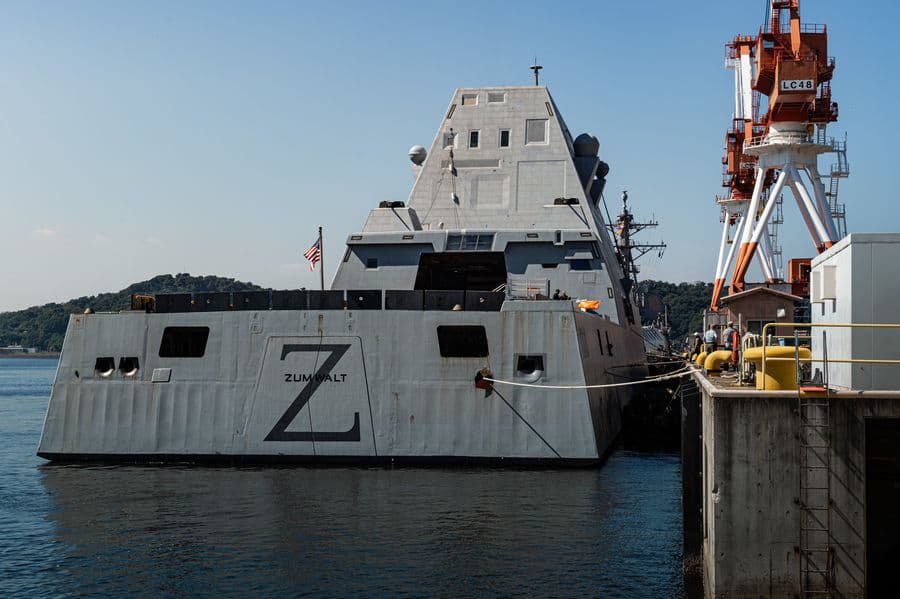
Another ship acquisition failure is DDG-1000. This class has never provided any real operational availability to the Fleet; it is not now, nor has it ever been, a “destroyer” in any sense of the ship class term. The Navy’s big hope – after the failure of the Advanced Gun System (AGS) – is to equip DDG-1000 with yet-to-be-fielded hypersonic weapons.
- Proposed solution: decommission all three ships of the class and turn them over to the shipyards until all functional modifications are complete and hypersonic weapons are fielded and produced in volume. When ready, re-commission them as Land-Attack Cruisers (CA), which is functionally what they always were, and make them the centerpiece of small land-attack surface action groups (SAGs) that could operate independently or be attached to Expeditionary Strike Groups (ESGs) in support of amphibius operations or Carrier Strike Groups (CSGs) in support of larger strike operations. Being inherently stealthy, experiment with DDG-1000 operating entirely on its own in land-attack missions.
- Benefits: de-commissioning the ships for some period of time would free up sea-going Sailors that could be distributed to under-crewed ships in the Fleet, and free up funds that could be re-directed to new ship acquisition.
A growing acquisition failure is the USS Constellation (FFG-62) program. According to the Government Accountability Office (GAO):
…the Navy’s decision to begin construction [of the first FFG-62] before the design was complete is inconsistent with leading ship design practices and jeopardizedapproach….
Delays in completing the ship design have created mounting construction delays. The Navy acknowledges that the April 2026 delivery date, set in the contract at award, is unachievable. The lead frigate is forecasted to be delivered 36 months later than initially planned. The program office tracks and reports design progress, but its design stability metric hinges largely on the quantity—rather than quality—of completed design documents. This limits insight into whether the program’s schedule is achievable. If the Navy begins construction on the second frigate without improving this metric, it risks repeating the same errors that resulted in construction disruptions and delays with the lead frigate….
The frigate is using a traditional, linear development approach for design and construction. The Navy has historically experienced schedule delays, cost growth, or both in prior shipbuilding programs using this approach.[v]
The FFG-62 program is now delayed by three years (!) and becomes more expensive every day. The Navy’s original estimate was that the lead ship, always the most expensive ship in the class, would cost approximately $1.3B. It is much more likely that FFG-62 will cost closer to $2B by the time it is eventually complete – and there is no surety – none whatsoever – that FFG-62 will be delayed by only three years – I repeat, none.
- Proposed solution: bear whatever cost, piss off whoever you need to hire the lawyers necessary, propose whatever legislation, etc., etc., etc., but get out of this train wreck and cancel this program now. The Navy should follow one of the following three paths to develop a true frigate, not a mini-cruiser like FFG-62, focused on primary mission areas of anti-submarine and anti-surface warfare (ASW/ASUW):
- Modify the Coast Guard’s Legend-class National Security Cutter (NSC) to add CAPTAS-4, as many VLS cells as possible, a close-in weapon system (CIWS – either Phalanx Block 1B or RAM/SeaRam), and upgraded sensors and combat system (but no SPY radar system: it is overly expensive and not necessary);[vi]
- Similarly modify the Coast Guard’s Heritage-class Offshore Patrol Cutter (OPC); or, and this is my preferred option, first suggested to OPNAV ten years ago:
- Build a new version of the Oliver Hazard Perry-class FFG-7 with VLS replacing the Mk13 launcher, CAPTAS-4 replacing AN/SQR-19, remove the over-the-side (OTS) torpedo system, and update the sensors and combat system. With two hangars and the current ability to carry two MH-60R helicopters, a new version of FFG-7 would be ideally suited for the employment of future unmanned aerial systems (UAVs).
- Benefits: after LCS and DDG-1000 it is amazing that Congress still provides the Navy with any ship acquisition funds at all.[vii] The Navy needs to re-build trust with Congress and the American people that they can actually acquire a functioning warship at a reasonable cost in a reasonable timeframe.
Finally, a past analysis showed that the U.S. Navy is top-heavy in large surface combatants (LSCs) and not structured for expeditionary operations.[viii]
- Proposed solution: continue phasing out AEGIS cruisers as they reach service life expectancy, begin aggressively de-commissioning older DDG 51-class ships and mothballing them, scrap plans to develop a new DDG(X)[ix] any time soon, and de-commission any ship that is in a yard status greater than 12 months, starting with CVNs in multi-year refueling periods.
- Benefits: de-commissioning ships would free up sea-going Sailors that could be distributed to under-crewed ships in the Fleet, free up funds that could be re-directed to new ship acquisition, and mothballing ships would provide a store of modern warships that could be re-activated in time of crisis. Given the Navy’s track record in developing new ship designs, coupled with the imbalance of too many LSCs, the ongoing construction of Flight III DDG-51’s, the need to build small surface combatants (SSCs), and the need to re-balance to re-establish an expeditionary Fleet (see below), the Navy cannot afford a new LSC design.
In closing, the following previous recommendations still stand:
- Expeditionary Navy. In the past, I have provided background, rational, strategy, and force structure for building a navy that can carry the fight to any opponent overseas.[x] The right number of ships is 351.[xi] Those recommendations stand.
- Operational tempo (OPTEMPO). The number one thing the Navy can do to improve force material readiness, morale, and retention is return to predictable six-month long deployments. OPTEMPO necessarily got out of whack after 9/11 as the Navy adjusted to support operations in Afghanistan, and then again in Iraq, but those efforts are largely over, and the Navy needs to return to a rational and sustainable level of effort. I realize that the Goldwater-Nichols Act removed OPTEMPO decisions from the CNO’s authority, but the CNO should pound on the Tank table at every opportunity, until the CJCS throws them out of the room, or until DoD gets a handle on the currently unsustainable OPTEMPO levels.
I wish the CNO all the best!
Anthony Cowden is the Managing Director of Stari Consulting Services, co-author of Fighting the Fleet: Operational Art and Modern Fleet Combat, author of The Naval Institute Almanac of the U.S. Navy, and was a commissioned officer in the U.S. Navy for 37 years.
Notes:
[i] https://www.realcleardefense.com/articles/2023/07/31/some_unsolicited_advice_for_the_next_cno_969640.html
[iii] Or, maybe not: https://ogles.house.gov/media/press-releases/rep-ogles-proposes-amending-22nd-amendment-allow-trump-serve-third-term
[v] https://news.usni.org/2024/12/27/report-to-congress-on-navy-constellation-class-frigate-program-2
[vi] Congress should pass a law mandating that the largest Coast Guard cutters be co-developed as Navy frigates, the only difference being the additional weapon systems and sensors on the Navy variant. In addition to cost savings in the design and building of the hull, mechanical and electrical (HME) systems, in time of national crisis the USCG variant could be upgraded to the Navy variant.
[vii] Yeah, I said it – but I don’t think people have fully grasped how much the American people are in a “tear it all down!” mood and how committed this administration is to actually tearing things down they think need tearing down…
[viii] https://www.realcleardefense.com/articles/2023/04/25/updated_an_expeditionary_navy_for_an_era_of_great_power_competition_895584.html

ICE Is Not a Four-Letter Word
By Meda Parameswara Reddy • RealClearDefense
The U.S. Can Draw Down in the Middle East Without Going Blind
By Cudi Zerey • RealClearDefense
America Needs a Joseph Directive
By Jeff Ballabon • RealClearDefense
Partnering Decides Whether Flexible Military Construction Can Work
By Matt Russell • RealClearDefense
Eight Months of Epic Fury and Still No Internal Alternative
By Stephen D. Cook • RealClearDefense

GE Aerospace to Supply Engines for Two US Navy Flight III Destroyers
By Defense Post
U.S. Air Force Asks Industry for New Cruise Missile for Ukraine
By Michael Peck, DNews
First Flight II San Antonio-class Amphib Completes Builder’s Trials
By Mongilio, USNI N.
LGM-35 Sentinel ICBM on Track for 2030
By Kris Osborn, Warrior Maven
On American Destroyers, Avoid a Self-Inflicted Wound in Spain
By Defense News