
Army Recruiting and Post Renaming
Last updated 05:52 PM EST • Read time: 8m
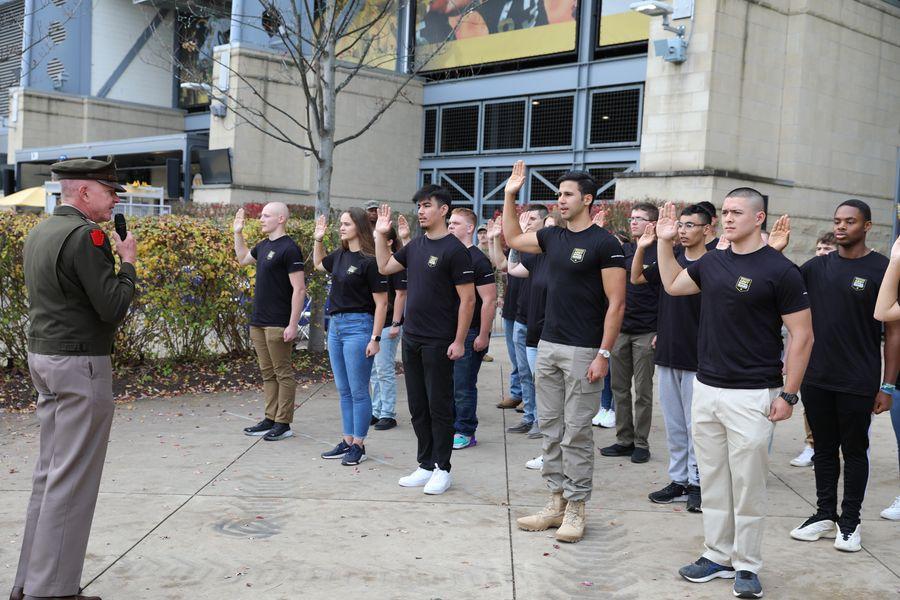
The U.S. Army’s recruiting woes are “front and center” these days. Ink flows freely on both the causes and viable solutions for fiscal year 2022’s shortfall of 15,000 new Soldiers (of 60,000 sought). Just as seriously, the Army is expanding its pre-boot camp course for overweight and low-scoring so-called “Nintendo Generation” applicants, expending more of its already stretched resources to achieve what formerly constituted the starting point for most basic trainees. (Earlier this year, a Pentagon report assessed that only 23 percent of Generation Z were eligible for military service based mostly on academic and fitness scores. “Un-good,” as Orwell’s Nineteen Eighty-Four has it.)
But the proverbial “elephant in the room” – the Army’s “wokeness,” in lockstep with the rest of the Pentagon – often goes unmentioned in official or inside-the-Beltway circles as a factor for the Army’s recruiting challenges. It isn’t politically acceptable to do so. Unlike some senior administration officials, I’ll provide a definition of wokeness: “Any ideology, policy, program, or practice that tends to divide individuals based on superficial characteristics within an oppressor-oppressed paradigm.”
Take one issue, the redesignating of Army posts named for Confederate generals. At present, nine such Army installations are to be redesignated at an official estimated cost of $62 million, most likely a low figure. For a budget-strapped service – at least outside Washington where the Treasury’s printing presses reside – this seems like real money. The current Heritage Foundation assessment of U.S. military power states the Army “finds itself under extraordinary operational and financial pressure” and rates the Army overall as “Marginal.” The Secretary of the Army has stated the objective of “a sustainable strategic path” for the Service is problematic and unclear.
Yet the costly post renamings will not add one iota to the U.S. Army’s actual combat readiness. How much Soldier training, new equipment, post infrastructure improvements, and so on might be paid for with that money?
Not only are these redesignations costly in dollars. Such measures surely will give pause to many Southerners – mostly white men – as they consider whether or not to enter the Army. So what, you may ask, especially since white men are assumed blameworthy for most problems in 2022 America. Here’s why this matters.
First, this demographic traditionally serves in the military – and dies during wartime – in numbers and at rates at least equal to those of other groups. Since 2001, nearly one-third (31.8 percent) of all U.S. military deaths in Iraq and Afghanistan hailed from the eleven States that withdrew from these “United States” in 1860-1861 (Statista.com). The pigmentation of those who died in service matters not at all – each deserves honor – but the fact remains that the vast majority were white. Contrary to Critical Race Theory (CRT) fabulists, neither in Vietnam nor since 2001 did the facts concerning U.S. ground combat fatalities support the assertion that black Soldiers and Marines were used as “cannon fodder” by the Pentagon. Of the Vietnam conflict, U.S. Army Col. Harry Summers wrote, “. . . the evidence is those who died in Vietnam were mostly ‘white, middle class and volunteers.’ And so were most who served there as well.” The same could rightly be said of the U.S. experience in hostilities since 2001, in which 82 percent of U.S. ground combat losses in Iraq, and 85 percent in Afghanistan, were white (Congressional Research Service Report RL32492, 2020 update). Moreover, in 2000 whites accounted for 75 percent of the U.S. population, meaning that their combat loss rate in the 20 years that followed was considerably higher than their share of the population.
Consider these facts from several sources. In June 2022, an American Homefront Project article cited Pew Research Center data that “60% of veterans under 40 have an immediate family member who served” in the military. “Among new recruits, 30% have a parent in the military, and 70% report a family member in the armed forces.” In August 2017, a Slate.com piece noted, “. . . perhaps the strongest predictor of military service is having a family member who served – allowing for extended family members, it averages to about 80 percent of new recruits across the services.” Moreover, the South contributes “more than its fair share of 18-24 year olds to military service: 44.3 percent of new recruits in 2015, 20 percent more than the region’s share of the total U.S. population [emphasis added].” In March 2016, a Time article referenced a Pentagon report showing that 79% of Army accessions during 2012-2013 had a close relative who had served in the military.
So, what’s the point? As Time observed, “Relatives are what the military calls key ‘influencers’ because of their ability to steer young people into, or away from, the military.”
In the current climate, how many veterans whose sons, daughters, nephews, nieces, or grandchildren are considering Army service will “influence” them away from serving based on the Army’s divisive policies? Post renamings are only one tangible example. No doubt, there are more than a few veterans – proud of their own and their family’s legacy of military service, some with an ancestor who fought for the South – who will never refer to a renamed post regardless of its new designation. Such veterans have a point. First, that’s not how they knew the post. Second, adopting a new designation in the current climate appears to legitimize the Army’s divisive practices.
In addition to Army posts, there are now similar, smaller-scale cases at institutions nationwide. Especially regarding the Old South’s heritage, the Virginia Military Institute – which I’ve addressed elsewhere, repeatedly – offers an excellent example. In the last two years, not only has the statue of “Stonewall” Jackson been removed from its prominent position in front of the cadet barracks, but his name was physically removed from the barracks’ stone archway a few yards away. This was not inexpensive. The designation of the nearby building formerly known as Jackson Memorial Hall suffered the same fate. But these French Revolution-style cleansings do not satisfy. It is, as wise Solomon wrote, the “fire that never says, ‘Enough.’” Renamings do, however, inculcate in some cadets the mindset of always looking for some supposed oppression, perpetrated by those who are the moral inferiors to today’s Purity Test standard bearers – themselves.
In relational terms, this is unhelpful. In military terms, it is disastrous. It promotes the exact opposite of leadership, cohesiveness, and morale – essential qualities for successful military operations. This isn’t rocket science. But a little military history reading might help one who doubts. The point is that what has happened at VMI is happening in the Army on a much larger scale. (In the fall of 2022, VMI experienced a one-quarter decline in new cadets, the same percentage shortfall as the Army’s.)
In short, the impact on recruiting from redesignating Confederate-named posts may be difficult to quantify. But especially in the South, where family traditions of military service are strongest, the number of would-be Soldiers who decide to forego Army service on account of CRT-informed divisive policies will not be zero. The renaming phenomenon goes hand-in-hand with the Pentagon’s default position of viewing white men as rather likely to be extremists, racists, bigots, or what have you, entirely absent any evidence for the charges. In early 2021, the Pentagon wasted considerable money and military man-hours in its hunt for “extremists” in the ranks. Eventually it managed to identify about one hundred. Miniscule, a statistical zero. Why should a Southern white man who wants to serve subject himself to such a culture of suspicion?
In my own small circle, I know well two outstanding young men who changed course after a year or more of military training intended to lead to their commissioning as second lieutenants (one Army, one Air Force). One came from a military family, the other did not. Both of them decided to withdraw from their programs to no small degree because of wokeness and the unattractive, divisive culture they experienced at what previously had been excellent undergraduate institutions.
Meanwhile, the Pentagon’s 2022 Annual Report to Congress on the PRC notes the Chinese continue aggressive military modernization, while simultaneously employing diplomatic measures “to erode U.S. and partner influence” in various regions and hotspots. Clearly, any sane observer realizes the clock is nearing midnight for the U.S. Army to return to its raison d’être and to ditch its disruptive social-political activism typified by redesignating historic posts named for Confederates.
Forrest L. Marion is a retired U.S. Air Force Reserve colonel and has a Ph.D. in U.S. history from the University of Tennessee. He is an oral historian and staff historian at the Air Force Historical Research Agency, Maxwell Air Force Base, Alabama. He deployed as joint task force historian to the southern Philippines (2002) and as air advisor wing historian to Afghanistan (2009, 2011). Forrest is also the author of "Flight Risk: The Coalition's Air Advisory Mission in Afghanistan, 2005-2015" (Naval Institute Press, 2018), and (forthcoming), "Standing Up Space Force: The Road to the Nation's Sixth Armed Service" (Naval Institute Press).

2949 Marine Prisoners, Hostages, and Peacetime Governmental Detainees Since Our Corps' Founding
By Jon Couch • RealClearDefense
America Must Win the Biotech Race Against China
By Rob Maness • RealClearDefense
How Digital Twins Can Strengthen Naval Readiness Before a Crisis Begins
By Carl Napoletano • RealClearDefense
The Uninsured Sky
By Joe Sandri • RealClearDefense
Counterterrorism and the Growing Convergence in Homeland Security and Homeland Defense
By Austin Doctor • RealClearDefense
How Digital Twins Can Strengthen Naval Readiness Before a Crisis Begins
By Carl Napoletano • RealClearDefense
F-16s Build on Iran Combat Lessons to Prepare for China Threat
By Rebecca Grant • Lexington Institute
U.S. Aircraft Evacuated From Second U.K. Base Due to Iran Threat
By Holliday, et al, WSJ
US Marine Corps Acquires Textron’s Ripsaw M3 Uncrewed Ground Vehicles
By DPost
U.S. Navy’s First San Antonio Flight II USS Harrisburg Completes Sea Trials
By GDN