
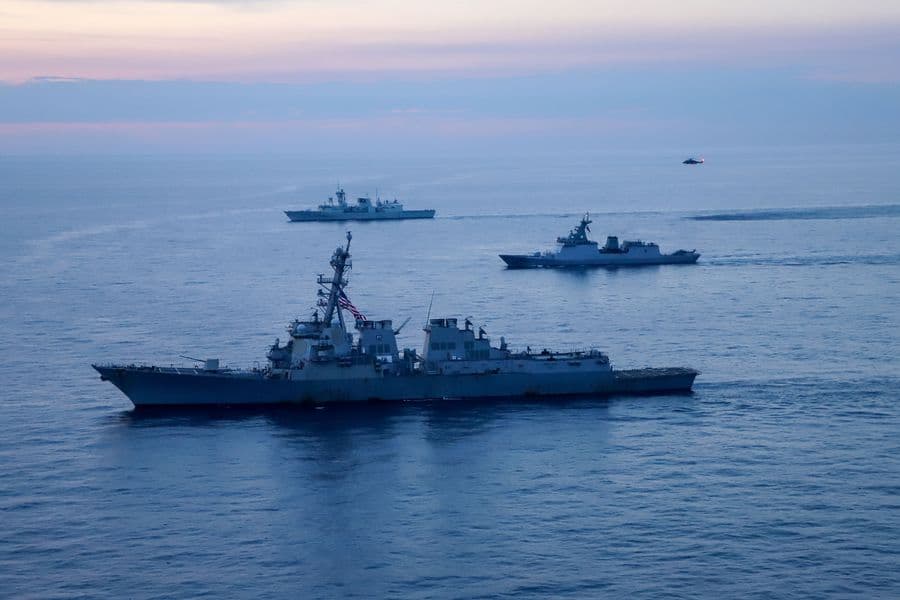
A Call to Act in the Indo-Pacific
Last updated 06:31 AM EST • Read time: 5m
As the United States prepares for a new administration, it faces a defining moment in the Indo-Pacific region. The decisions made now will have lasting implications for regional stability and U.S. strategic interests. The Trump administration has the opportunity to implement its earlier strategy directives aimed at building effective deterrence and competitive actions against China as well as build on earlier directives and initiatives inherited from the Biden administration that strengthened alliances, partnerships, and the defense industrial base. To counter mounting threats from China, Russia, and North Korea, the U.S. must prioritize decisive action over prolonged assessments and focus on five critical areas: reinforcing military capabilities, reforming Pentagon bureaucracy, expanding economic engagement, strengthening alliances, and integrating industry partnerships.
Reinforce Military Capabilities and Deterrence
China’s aggressive actions in the South China Sea and Taiwan Strait, its collaboration with Russia, and North Korea’s provocations underscore the urgency of bolstering U.S. deterrence. These adversaries are testing U.S. resolve, seeking to reshape the global order. Any hesitation risks emboldening their ambitions.
The U.S. must grow and modernize its nuclear arsenal, invest in long-range precision fires, and underwater capabilities, enhance air and missile defense systems, focus on logistics, and strengthen cyber defenses. Strategic positioning of assets to cover hotspots like the Taiwan Strait, South China Sea, and Korean Peninsula is crucial to ensuring a credible deterrent. Delays in reinforcing these capabilities only provide adversaries with the opportunity to advance their own military power unchecked.
Reform Pentagon Bureaucracy and Reallocate Resources
The Pentagon’s inefficiencies hinder timely responses to evolving threats. While long-term reforms are necessary, immediate measures can improve cross-service collaboration in the Indo-Pacific. A senior official dedicated to Indo-Pacific prioritization should be appointed to report directly to top defense leaders and streamline resource allocation. This role would bypass bureaucratic delays, ensuring that Indo-Pacific commands receive the support they need without unnecessary obstacles.
Quickening decision-making processes and reallocating resources to align with Indo-Pacific needs will enable the U.S. to address mission-critical objectives effectively and efficiently.
Expand Economic Engagement for Security
Military strength alone cannot counterbalance China’s influence. Economic leadership is equally vital. By investing in telecommunications, infrastructure, and emerging technologies, the U.S. can solidify its position as a preferred partner in the region.
U.S. agencies such as the International Development Finance Corporation (DFC) and Export-Import Bank (EXIM) should be mobilized to support strategic investments in Indo-Pacific nations. Encouraging secure telecommunications solutions over providers like Huawei will enhance regional security. Tax incentives, grants, and loans can promote local and allied sourcing for defense and technological products, fostering economic security and reducing dependence on China.
Additionally, partnerships with Indo-Pacific nations to share talent, establish joint manufacturing centers, and collaborate on technology will strengthen regional ties and economic resilience.
Strengthen Alliances and Build Regional Resilience
To counter adversarial coercion, the U.S. must enhance its diplomatic presence, fortify supply chains, and expand defense partnerships in the Indo-Pacific. Initiatives like the Partnership for Indo-Pacific Resilience should be continued and expanded, focusing on industrial resilience and joint defense capabilities.
Enhanced training exercises, robust infrastructure development, and supply chain fortification will build trust and cohesion among regional allies. These efforts will encourage partners to take greater responsibility for their own defense, mutually benefiting collective security.
European allies also have a vital role to play. Initiatives such as freedom of navigation operations, AUKUS collaboration, and the NATO Industrial Capacity Expansion Pledge strengthen transatlantic contributions to Indo-Pacific security. These efforts align with the shared goal of deterring aggression and replenishing defense stockpiles critical for both the Indo-Pacific and European theaters.
Engage Industry as a Key Strategic Partner
The private sector’s innovation and agility are essential for maintaining a technological edge in national security. Clear communication of mission requirements and objectives will enable industry to align its resources and capabilities with defense priorities.
Multiyear contracts can incentivize industry participation, fostering commitment and innovation in critical areas like data security and information sharing, defense technologies and armaments, and logistical support. By involving industry in strategic planning from the outset, the U.S. can accelerate progress and ensure a united approach to counter adversarial advances.
In an environment where adversaries leverage resources to disrupt U.S. influence, a robust public-private partnership is crucial to maintaining a competitive edge.
A Call to Act
The U.S. cannot afford further delays in addressing the growing threats in the Indo-Pacific. Swift, unified action is essential to safeguard regional stability and maintain U.S. influence.
Actionable policies to strengthen deterrence, streamline Pentagon practices, deepen economic ties, reinforce alliances, and partner with industry are necessary. At the same time, while focusing on the Indo-Pacific, none of this is to suggest that we should neglect our commitments in Europe as the convergence of threats from China and Russia demonstrates the need for a comprehensive approach.
By acting decisively now, the U.S. can shape a secure, rules-based order in the Indo-Pacific, ensuring its interests and values endure for generations to come.
Kimberly Lehn is the Senior Director for the Honolulu Defense Forum at the Pacific Forum. The Honolulu Defense Forum is a solutions-based conference that partners with U.S. and ally government stakeholders and the defense and technology industry to discuss ways of overcoming defense and economic security challenges in the Indo-Pacific region. It will take place on February 13-14, 2025, in Waikiki.

The Services Do Not Need a Four-Star Autonomous Warfare Command
By Steven Wills • RealClearDefense
Honor Them While There Is Still Time
By Jeffrey Rosales • RealClearDefense
From Siberia to Fairford: How Operation Spider’s Web Has Changed the Rules of Airpower
By Frank A. Rose • RealClearDefense
Faster Simulations, Better Defense Decisions
By Rut Lineswala • RealClearDefense
Will HASC Have an Oversight Subcommittee in the Next Congress?
By Christopher J. Bright • RealClearDefense

Hegseth Barred Trans Troops. Military Boards Are Rejecting Those Orders.
By NYT
Closing the Sea: Lessons from Ancient Mediterranean Blockades
By DeCasien, CIMSECFrom Siberia to Fairford: How Operation Spider’s Web Has Changed the Rules of Airpower
By Frank A. Rose • RealClearDefenseFaster Simulations, Better Defense Decisions
By Rut Lineswala • RealClearDefense
Bombers Could Have a Major Air-to-Air Combat Role
By Joseph Trevithick, The WarZone