
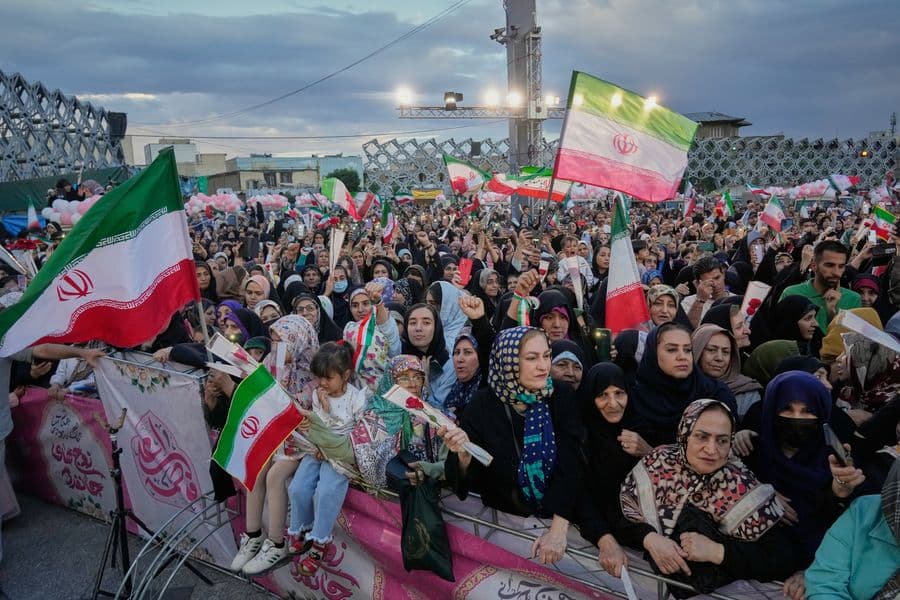
For Tehran, Survival Is Victory
Last updated 11:08 PM EDT • Read time: 4m
At a cabinet meeting in 1967, two years into major combat operations in South Vietnam, President Lyndon Johnson posed a salient question: “What does Ho Chi Minh want?”
Presidential adviser John P. Roche answered succinctly: “Ho wants to win.” This caused a stir in the cabinet room because no one had yet been so blunt about this with LBJ.
Johnson waved Roche off, saying, “Well, old Ho can't have that.” But eight years later, North Vietnamese troops rolled into Saigon, South Vietnam was defeated, and the United States was humiliated.
Today we might well ask, what does Tehran want? The answer is the same; they want to win. And by the regime’s terms, they might get what they want.
Iran’s victory narrative can be boiled down to one word: survival. All they need to do is come out of this thing alive and they will claim victory.
After all, they are facing off against a country that purports to be the world's superpower. Simply emerging from the war in one battered piece means they were able to stand up to the hegemon.
The US victory narrative is more complex but can be summed up as containment. The US does seek to destroy Iran but to limit it.
No nuclear weapons, no uranium enrichment, a reduced missile program, no support for terrorist proxies. In this framework a diplomatic process leading to a comprehensive arms control agreement would constitute a type of victory. US negotiators are actively searching for ways to make such a deal palatable to the Mullahs.
It sounds easy enough. Iran could simply agree to whatever deal is put in front of them and the pain would stop. The US would end the blockade, lift sanctions, maybe unfreeze assets.
Tehran could just sign on the dotted line with the full knowledge that they could reap the rewards sooner and cheat on the agreement later.
However even given this convenient off-ramp, Iran resists, even pushes back. Tehran sees negotiations as war by other means. So they routinely counter US proposals with increased demands.
They not only close the Strait of Hormuz, they claim that after the war they will control it, and the internet cables running through it. They refuse to discuss the issues America wants addressed and call for reparations. They front-load their demands as preconditions even to starting talks. This is not the language of losers, not the attitude of a country that has been defeated.
We saw the same dynamic with Israel's war against Hamas. Through repeated phases of harsh conflict, terrorists hiding in tunnels beneath the Gaza rubble refused to release hostages, to disarm, or to admit they were losing.
And even though they ultimately returned the hostages, Hamas still claims to be the victor and refuses to disarm. That effort took two years of ground operations in an area a fraction of the size of Iran.
Like Hamas, Iran is content to draw out the conflict. They know that the longer the war drags on the more political problems it causes for the White House, domestically and abroad.
Since the United States is apparently unwilling to take the steps necessary to end the regime, Tehran believes it cannot truly be defeated.
Even if the United States reaches a deal with Iran and claims victory, it would resolve nothing. Any deal signed with Iran would be temporary, and without firm verification and enforcement it will be meaningless.
The Mullahs will go right back to building missiles and drones, supporting terrorists, and covertly developing nuclear weapons. They will push back against containment by every means at their disposal.
And they will have a burning new motive for punishing the “Great Satan,” revenge for complicity in killing their Supreme Leader Ali Khameini.
This war will not end with an arms deal any more than the Vietnam War ended with the Paris Peace Accords. The Mullahs will emerge battered, isolated, and economically shattered, yet still declare victory because the regime endured.
And that is the uncomfortable reality Washington still struggles to grasp: for revolutionary states, not losing is winning.
Ho Chi Minh understood that. Tehran does too.
James S. Robbins is the Dean of Academics at the Institute of World Politics and author of This Time We Win: Revisiting the Tet Offensive.
A Passage to the Middle East: India as a Mediator and Security Partner
By Irina Tsukerman • RealClearDefense
South China Sea is Key to Invigorate Positive U.S.–Malaysia Relations
By Brent D. Sadler • RealClearDefense
The Necropolitics of the Wasteland
By Yunus Emre Tumen • RealClearDefense
AI, Robotics, and Marines
By Gary Anderson • RealClearDefense
The Emerging SQUAD
By Muhammad Shoaib • RealClearDefense
AI, Robotics, and Marines
By Gary Anderson • RealClearDefense
AUKUS Partners Test Autonomous Maritime Systems
By Jangoulun Singsit, Naval Tech
AUKUS: USS Colorado Announced as First Submarine for SRF – West
By USNI News
Navy, Marine Corps Simulate Ship Strikes From Air and Land
By Alex Wilson, S&S
Air National Guard To Stand Up a New Special Tactics Squadron
By Patty Nieberg, T&P