
Choose Wisely: Three Considerations for Army on FLRAA
Last updated 09:52 PM EDT • Read time: 5m
A shortsighted FLRAA decision risks breaking the DIB
With Army pushing its decision on the Future Long Range Assault Aircraft (FLRAA) contract to September, service leaders have a window of time to look closely at its impact on the rotary industrial base. Amid uncertainty over other Army aviation programs, their analysis on FLRAA should be thorough: the right balance in the industrial base delivers the best products for the long-term, and Army leaders have a duty to ensure that balance.
A shortsighted decision on FLRAA – a key part of the Army’s Future Vertical Lift (FVL) program – would deal a seismic blow to the defense industrial base, opening cracks in the foundation under not only contractors and their talented workforces, but also the warfighters who depend on these platforms.
To avoid this, the Army should conduct a thorough review that considers three key factors, as identified by Dr. Jerry McGinn, executive director at George Mason University’s Center for Government Contracting. They should look through a trifocal lens at:
- The number of competitors available,
- The company capabilities, and
- The tools Army has on hand to keep those competitors for the long term.
If they do, there’s real opportunity to craft a prudent, effective acquisition policy for the future of army aviation.
Number of competitors
With three major providers, Bell, Sikorsky, and Boeing, the rotary wing industrial base is robust – at least for the moment. But if only one company is selected for FLRAA – a contract expected to last for the next 50 years – the industrial base becomes less stable practically overnight.
For example: Bell and Boeing have extended contracts for new airframes some of which, like the V-22 Osprey, are expected to be in service through 2055. Boeing also has contracts for the Chinook (delivery expected in 2024) and Apache (delivery through 2026). Boeing has also partnered with Sikorsky on a joint entry for the FLRAA competition.
By contrast, Sikorsky confronts Air Force plans to reduce its buy of the Jolly Green II combat rescue helicopter by one third at the same time as the Marine Corps is planning a 34% reduction of Sikorsky’s CH-53K King Stallion platform. Consider now that Sikorsky’s Black Hawks will phase out over time as FLRAA ultimately replaces them. If the Future Vertical Lift contract were to be awarded to an industry competitor that isn’t Sikorsky, the impact could be significant - one leg of the rotary industrial base tripod would be significantly impacted.
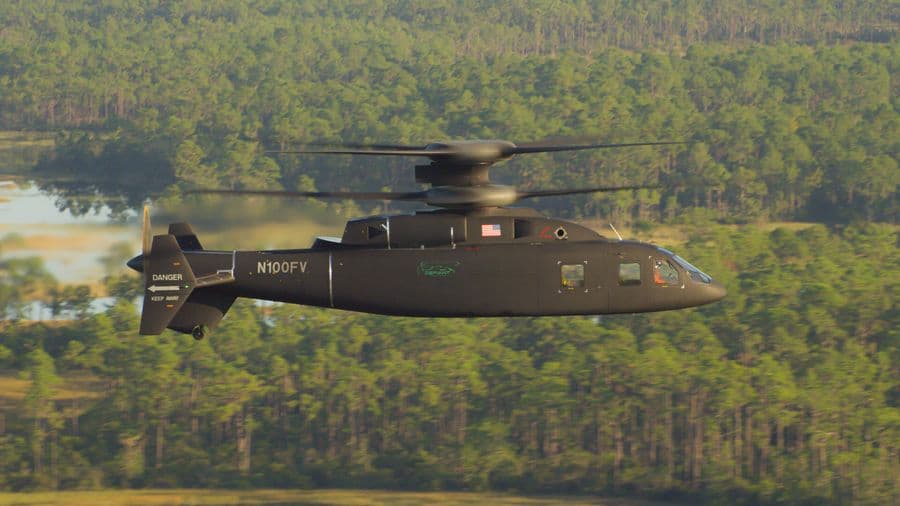
This delicate balance is not about charity, it’s about keeping engineers working and production going to maintain capacity. The reality is the Sikorsky-Boeing FLRAA offering — the Defiant X — is an extremely capable platform. Its maneuverability is especially noteworthy, and its mass confined area landings mission profile will let Army quickly concentrate combat power without having to resort to a larger frame that’s incompatible with existing hangers and ramps the world over.
As a former combat helicopter pilot, this is an extremely desirable capability.
Company capabilities
To assess the capabilities of companies in the rotary industrial base, the Army needs to examine technology competency, the availability of materials, and the manufacturing capacity to design, create, and build systems to meet the specifications.
Perhaps most essential is the capability to attract and retain top talent. This is another key consideration for Army on FLRAA: if the base is thrown out of balance, will contractors be able to select the best talent downstream?
Keeping competitors warm
Like all defense acquisitions, the Army needs to play the long game on a FLRAA. Awarding franchise programs without opportunities for competition down the road is inherently destabilizing. Supply chain challenges and the looming threat of recession amid the most challenging international security environment in generations further complicates the picture for defense companies.
One tool Army might consider to mitigate these risks is awarding two contractors for FLRAA. There is precedent for this, in both present-day submarine acquisitions and the fighter and bomber aircraft acquisitions of WWII. (In the latter case, scores of contractors worked to deliver airframes in unbelievably short time spans; at one point in 1944, multiple manufacturers were collaborating to produce 16 B-24s per day.)
Similarly, the Army might consider which development projects could be awarded to non-awardees to keep them in the game.
The stakes for a prudent, long-term decision
I flew multiple combat tours as a OH-58D Kiowa Warrior pilot in Iraq and Afghanistan. I have lived the down-range impact of acquisitions decisions, both the successes and failures. The bottom line: Army needs to make absolutely certain it looks closely at the impact of the FLRAA decision on the rotary industrial base. Army aviators like me and the people I served alongside will have to live with the consequences.
Amber Smith is a former OH-58D Kiowa Warrior helicopter pilot-in-command and air mission commander in the 101st Airborne Division. Previously she served as the Deputy Assistant to the Secretary of Defense (Outreach) and is a combat veteran of Iraq and Afghanistan. She is the author of Danger Close.

A Passage to the Middle East: India as a Mediator and Security Partner
By Irina Tsukerman • RealClearDefense
South China Sea is Key to Invigorate Positive U.S.–Malaysia Relations
By Brent D. Sadler • RealClearDefense
The Necropolitics of the Wasteland
By Yunus Emre Tumen • RealClearDefense
AI, Robotics, and Marines
By Gary Anderson • RealClearDefense
The Emerging SQUAD
By Muhammad Shoaib • RealClearDefense
AI, Robotics, and Marines
By Gary Anderson • RealClearDefense
AUKUS Partners Test Autonomous Maritime Systems
By Jangoulun Singsit, Naval Tech
AUKUS: USS Colorado Announced as First Submarine for SRF – West
By USNI News
Navy, Marine Corps Simulate Ship Strikes From Air and Land
By Alex Wilson, S&S
Air National Guard To Stand Up a New Special Tactics Squadron
By Patty Nieberg, T&P