
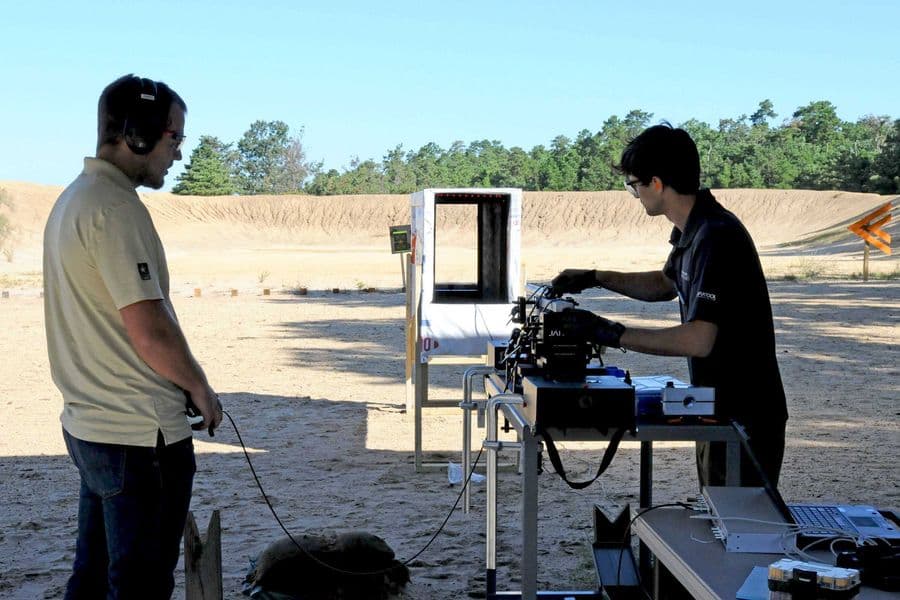
Next Generation Squad Weapon: Lethality & Reliability are Paramount
Last updated 07:47 AM EDT • Read time: 5m
Ukraine sets the scene, but Korea is the real guide. Lethality & reliability are paramount.
Russia’s invasion of Ukraine puts the possibility of peer-level conflict front and center for the U.S. Army. But as the service develops the Next Generation Squad Weapon (NGSW) to replace current legacy systems – the M4 carbine and M249 squad automatic weapon – it’s Korea’s lessons of grueling, large-scale infantry combat that leaders must keep firmly in mind. At the bare minimum, the NGSW must increase lethality, reliability, and range over Army’s current small arms. The Army should also be careful, as it has a long history of developing potential replacements to their legacy small arms that never entered production.
Korea: a case study
26 November 1950: in the hills above Korea’s Chosin Reservoir, the Intelligence and Reconnaissance Platoon of the 31st Regimental Combat Team was ambushed by large elements of the People’s Liberation Army, ordered across the Yalu River by Chairman Mao. A small contingent of Americans confronted hordes of Chinese soldiers in quilted khaki jackets firing Russian-made submachine guns. Every member of the platoon was killed or captured, and thus began the tragedy of Task Force Faith: the 31st Regimental Combat Team would be completely destroyed during its attempted withdrawal.
The brave but doomed U.S. soldiers carried weapons designed for their grandfathers. The M1918A2 BAR was a fine weapon – for 1918. But by the outbreak of the Korean War, it was a thoroughly dated tool that lacked a quick-change barrel and could only be fed with 20-round magazines. Its larger stablemate, the Browning M1918A6 light machine gun, was an ad hoc adaptation of the tripod-mounted M1919A4. At 32 ½-pounds unloaded, the moniker ‘light machine gun’ must have seemed like a cruel joke to the grunts who carried it.
In all, during the Korean War, the American GI's arms were slow-loading, heavy, and inadequate. The fault was in the decision to keep obsolescent weapons in service for far too long. Now in 2022, as Russia invades Ukraine and China seeks to upend the global power structure, U.S. small arms are, once again, long in the tooth.
Next-Generation Squad Weapon competition
The Army is weighing two different offers for the NGSW, one from Sig Sauer and the other a joint offering between Beretta USA and LoneStar Weapons Systems (LSWS). Both bring different advantages. Sig Sauer brings a super high-pressure round that achieves increased range, though the 85,000 PSI has drawn industry safety concerns that could affect barrel reliability. The Beretta USA-LSWS uses a lighter composite case cartridge and what’s known as a “bullpup” design with the action and magazine behind the trigger for a longer barrel but more compact weapon length. Historical precedent demands a focus on the key attributes of weight and reliability.
The NGSW will utilize a new 6.8mm round. This is a needed improvement that will grant a greater degree of flexibility within infantry squads. (The Russian forces invading Ukraine offer a stark reminder of this necessity: the current 5.56 round would be simply insufficient against them.) However, these improvements should not come at the cost of increased weight with the new weapon system. The average soldier already carries over 100 pounds, with loads of up to 200 pounds sometimes occurring on recent deployments in Afghanistan. A lighter cartridge could significantly reduce this burden, and here the 30% lighter True Velocity ammunition in the Beretta USA-LSWS may offer an advantage.
Critically, the reliability of the NGSW will be paramount to the safety of American troops in combat. New weapons systems often incur numerous teething difficulties when placed on the battlefield for the first time. But as Russia’s invasion of Ukraine shows, when a ground war begins, there is simply no time for that. This requirement could also boost Beretta USA-LSWS’s chances, given the Italian parent company is the world’s oldest manufacturer and its M9 was used as the Armed Forces standard service pistol for 30 years after a fierce competition to replace the M1911 in the mid-1980s – a contest that, ironically enough, also came down to Sig and Beretta USA.
Lastly, while the NGSW represents the best opportunity in decades for a quantum leap in both firepower and innovation, the ‘how’ of its development likely matters as much as the ‘what.’ Here again, the Army should let history be its guide.
During World War II, the U.S. Army Ordnance Department forged partnerships between commercial manufacturers to expedite and enhance the development of new weaponry. This allowed numerous ideas from across the industry to coalesce and build the M1 Carbine during World War II. The M1 Carbine utilized no less than ten commercial companies to build the weapon after Winchester Repeating Arms completed their prototype. To seize this opportunity for enhanced battlefield lethality, collaboration across the defense industry could prove essential in placing the best possible NGSW in the hands of U.S. troops. Our nation’s success in the next war could depend on it.
We will never know how the outcome may have been different for Task Force faith had the units been better equipped with more lethal, reliable weapons. What we do know is that we owe it to their descendants in the ranks today to field weapons designed for the times to deliver the lethality required to keep faith.
Matt DiRisio is a major in the U.S. Army and is currently attending the Command and General Staff College at Fort Leavenworth, Kansas. He is a logistician and previously served as an Assistant Professor at the United States Military Academy. He has completed two combat deployments to Afghanistan and has two history-related master’s degrees, focusing his research on military innovation and Finnish-Russian relations. He is the co-author of Lessons Learned: Battlefield Deception - From Alexander the Great to Norman Schwarzkopf and was one of the winners of the 2019 C. W. Bright Pixel Prize for the Best History and New Media Project at George Mason University. The views expressed in this article are those of the author and do not reflect the official policy or position of the United States Army.

A Passage to the Middle East: India as a Mediator and Security Partner
By Irina Tsukerman • RealClearDefense
South China Sea is Key to Invigorate Positive U.S.–Malaysia Relations
By Brent D. Sadler • RealClearDefense
The Necropolitics of the Wasteland
By Yunus Emre Tumen • RealClearDefense
AI, Robotics, and Marines
By Gary Anderson • RealClearDefense
The Emerging SQUAD
By Muhammad Shoaib • RealClearDefense
AI, Robotics, and Marines
By Gary Anderson • RealClearDefense
AUKUS Partners Test Autonomous Maritime Systems
By Jangoulun Singsit, Naval Tech
AUKUS: USS Colorado Announced as First Submarine for SRF – West
By USNI News
Navy, Marine Corps Simulate Ship Strikes From Air and Land
By Alex Wilson, S&S
Air National Guard To Stand Up a New Special Tactics Squadron
By Patty Nieberg, T&P