
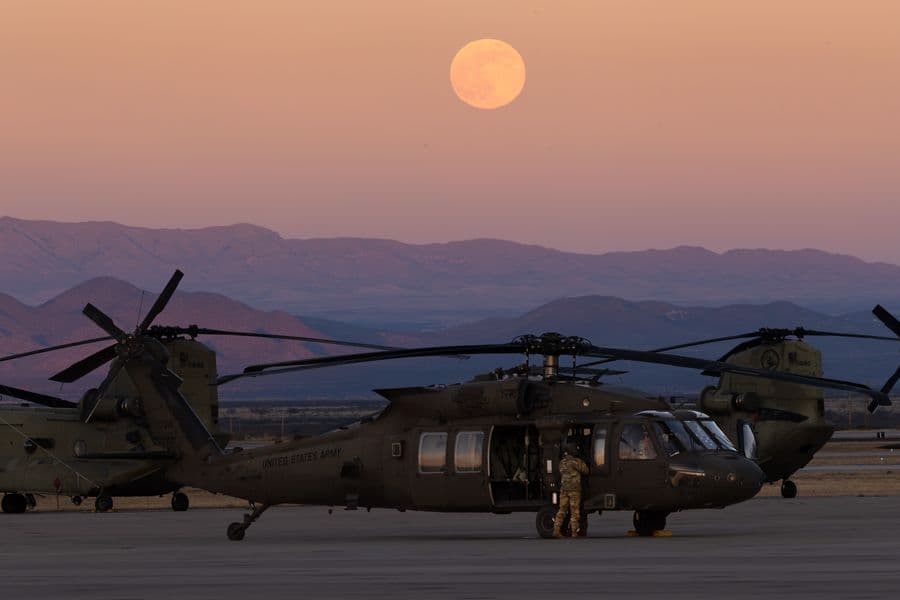
On Army Aviation, Multi-Year Procurement Beats Budgetary Whiplash
Last updated 07:28 AM EST • Read time: 5m
It’s been a consequential end of the year for Army aviation.
In September, the U.S. Army announced an aviation personnel reduction of 20% as the service transforms to “to meet the changing character of war.” As if on cue, in October, Sikorsky debuted the S-70 U-Hawk at AUSA as a fully autonomous, uncrewed version of the Black Hawk. Together, these two developments have set the new context for Army Aviation: a hunt for cost-savings and the embrace of emergent tech.
Army is right to pursue both, especially amid the changing character of war, but as it does the branch must keep in mind a truth that doesn’t change: uncertainty is expensive – for the American taxpayer and the defense industrial base their warriors depend upon.
As the Army builds the future of aviation, the service should continue its embrace of multi-year procurement (MYP) for its reliable workhorse, the Blackhawk. MYP’s most obvious benefit is financial, but there are reasons, too: continuity of the production line, labor force certainty, and, critically, foreign military sales.
As the international security landscape remains fraught, from Venezuela to the Indo-Pacific, it’s essential America’s Army keeps its present transportation capability relevant and its industrial base solvent.
MYP: Solvent Salve
Defense procurement is often hampered by short-term contracts that drive up costs and destabilize production. Multi-year contracts, like those used for Black Hawk helicopters, commit to purchasing equipment over several years, leveraging economies of scale and stability. Consider: in the 1980s, a single multi-year contract for 294 Black Hawk helicopters saved taxpayers $73.9 million. In 2017, a multiyear production contract for Black Hawk helicopters saved the Army $800 million — proof smarter procurement can deliver big results.
As the Army plans for continued production of Black Hawks, reports are the service is exploring contracting approaches other than an eleventh multi-year contract. The stated reason is a desire for more year-to-year budgetary flexibility. But given the proven savings of MY procurement versus other approaches, is it really the right policy to pay more than necessary for aircraft just for that optionality?
Given the Army needs about 100 more Black Hawks to replenish its fleet as it divests the oldest models – especially for the U.S. National Guard, which is short of its targets – paying a premium for these aircraft by buying year-to-year doesn’t make the economic sense Army is otherwise embracing. In fact, the success of MYP contracts, exemplified by the Black Hawk program, is such that they should be applied more widely to other aircraft programs to achieve cost savings, industrial stability, and greater efficiency.
MYPs strengthen the defense industrial base and provide predictable funding while economies of scale allow suppliers to offer volume discounts. Guaranteed multi-year work enables contractors to invest in facilities, equipment, and workforce training, keeping the supply chain robust. Consequently, predictable workloads help these companies avoid disruptions from fluctuating budgets, ensuring stable production lines.
Fewer contract negotiations also cut administrative overhead for both the government and the contractor, and these savings free up funds for other critical priorities while ensuring timely delivery of reliable aircraft. (This becomes all the more essential in light of Boeing’s labor dispute this autumn, which has saw more than 3,200 workers go on strike from early August to mid-November.)
Sticking with MYP for Black Hawk replenishments also mitigates financial risk as the Army plans significant investment in the new Bell MV-75 which was selected to complement the Black Hawk as part of the Future Long-Range Assault Aircraft program. MV-75 comes in, but Black Hawk isn’t going out. This makes it all the more important to ensure the Black Hawk supply base has a predictable demand signal to keep it healthy.
Foreign Military Sales
Currently, there are nearly 5,000 Black Hawks being operated by the United States and its allies, all of which require maintenance, which in turn requires a healthy industrial base. Like the United States, these allied militaries are expected to continue to rely on Blackhawk sustainment well into the 2070 timeframe. As no allied nation can assume the costs to upkeep the Black Hawk fleets, all of this makes a MYP decision highly consequential not only for America’s national security, but also for those of its allies and partners, too.
Critics might argue MYPs are risky if designs, funding, or requirements change, potentially locking the DoD into costly or outdated contracts. But statutory criteria ensure MYPs are only used for programs with stable designs, funding, and requirements. It is hard to think of a more stable or mature program than the Black Hawk. For decades it has been a case study in how MYPs work best – for proven systems, not early-stage programs.
In an era of tight budgets and global challenges, expanding multi-year procurement isn’t just smart — it’s essential for a stronger, more efficient defense. Army should keep the Black Hawk as the model of efficient procurement and production and continue using the contracting methodology that has worked and saved American taxpayers so much money to date.
Amber Smith is a former OH-58D Kiowa Warrior helicopter pilot-in-command and air mission commander in the 101st Airborne Division. Previously she served as the Deputy Assistant to the Secretary of Defense (Outreach) and is a combat veteran of Iraq and Afghanistan. For more information visit OfficialAmberSmith.com

A Passage to the Middle East: India as a Mediator and Security Partner
By Irina Tsukerman • RealClearDefense
South China Sea is Key to Invigorate Positive U.S.–Malaysia Relations
By Brent D. Sadler • RealClearDefense
The Necropolitics of the Wasteland
By Yunus Emre Tumen • RealClearDefense
AI, Robotics, and Marines
By Gary Anderson • RealClearDefense
The Emerging SQUAD
By Muhammad Shoaib • RealClearDefense
AI, Robotics, and Marines
By Gary Anderson • RealClearDefense
AUKUS Partners Test Autonomous Maritime Systems
By Jangoulun Singsit, Naval Tech
AUKUS: USS Colorado Announced as First Submarine for SRF – West
By USNI News
Navy, Marine Corps Simulate Ship Strikes From Air and Land
By Alex Wilson, S&S
Air National Guard To Stand Up a New Special Tactics Squadron
By Patty Nieberg, T&P