
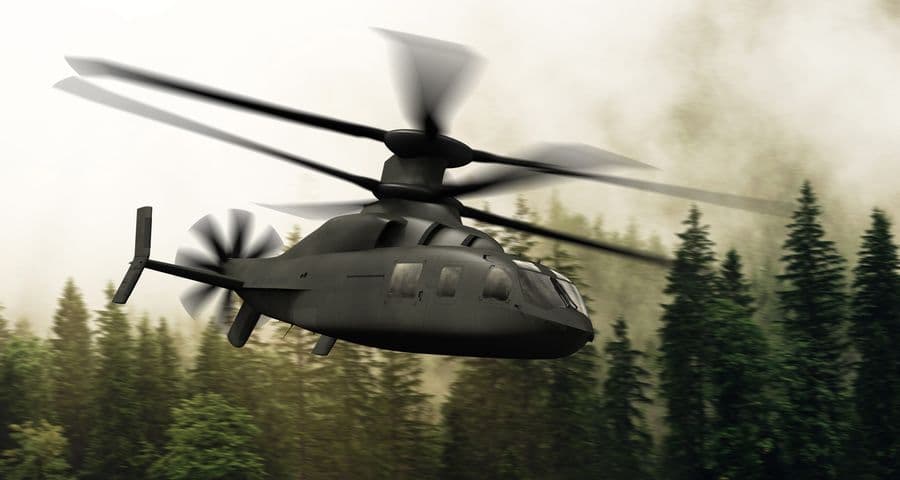
To "Correct the Sins of the Past," Army Aviation Should Go Defiant X
Last updated 05:08 PM EDT • Read time: 5m
At the recent Association of the U.S. Army’s conference in Washington, executive officer for aviation BG Robert Barrie stressed the need to address shared problems with shared solutions. Specifically, he said Army needs to learn by looking at past failures and “correct the sins of the past” when it comes to procurement. At the heart of this idea is repurposing where possible and not letting the perfect be the enemy of the really darn good.
Army has a chance to do exactly this in its Future of Vertical Lift competition between the Sikorsky-Boeing Defiant X helicopter and the Bell Textron’s V-280 Valor tiltrotor. In its search for the new Future Long-Range Assault Aircraft, the Defiant X should stand out because it can borrow pre-existing infrastructure, allowing Army to accomplish its mission, live within its means, and as Barrie said, “leverage [each investment dollar] to the greatest extent possible.”
Budget pressure cooker
Due to the over-shift from protracted counter-terrorism efforts to strategic competition, the nuclear triad is certain to consume much of DoD’s budget for the Air Force and Navy in the coming years – and Army leaders should expect heavy budgetary pressures. At the same time, Army Chief of Staff General McConville has said end strength will remain the same. This means there is only one area of the Army’s budget that can absorb the strain: modernization.
In this budget pressure cooker, Army’s FVL programs must look keenly at which options will incur additional costs and where they can save. With margins incredibly tight, the Army must learn from previous acquisition mistakes, especially the RAH-66 Comanche, the first of the armed aerial scout helicopter programs intended to replace the Kiowa Warrior helicopter – my old platform. On paper, the replacement was a great platform that provided an enormous upgrade to combat readiness. But it was riddled with logistical and sustainment challenges that ultimately resulted in program failure.
Comanche: 22 Years and $7 billion
Spending more than 22 years in development, the Comanche consumed 40% of the Army's aviation budget only for the service to receive just two prototypes. One of the Comanche’s many issues was its newness: integrating and debugging a host of interweaving new systems, from software to sensors, to more prosaic problems like weight and thrust. For all its speed in the air, Comanche was too slow in fixing these core issues and canceled the program in 2004 after climbing to a cost of $7 billion.
Later Kiowa replacement programs fared no better and were, in fact, so problematic they were never actually put in service, even though the Army still has the mission requirement. A replacement is now being considered once again under the Army’s FVL program.
As a pilot flying the OH-58D Kiowa Warrior helicopter for the 101st Airborne in both Afghanistan and Iraq, I saw firsthand the challenges arising from the disconnect between what planners in Washington wanted versus what service members in the field needed.
Correcting “sins of the past”
The best way for the Army to make good on General Barrie’s admonition to “correct the sins of the past” is to start making smart procurement decisions that produce long-term results. Service members must be given operational equipment that allows them to accomplish the mission in the wars we fight today while preparing for the wars that will be fought tomorrow.
As mentioned during the Center for Strategic and Budgetary Assessments webinar discussing their report on the Army’s Future of Vertical Lift program, “if it isn’t integrated into a way we fight wars, it’s a really interesting piece of equipment but isn’t doing much else.”
So what should the Army do?
Given Defiant X has many physical similarities to the Black Hawk, the Army should capitalize off its pre-existing infrastructure for training, maintenance, sustainment, logistical structure and shipping for spare and replacement parts (even special tools) for the Defiant procurement and repurpose where practical.
The Defiant has a similar rotor diameter to the Black Hawk, meaning current hangar and ramp space can be repurposed. By contrast, the Valor is considerably larger, requiring entirely new infrastructure that the Army can’t afford right now. When it comes to training new pilots, the Defiant will require less training time because pilots will simply be learning to fly a new helicopter, not an entirely new air vehicle. For the Valor, pilots will have to essentially learn to fly a helicopter, fixed wing and a tiltrotor. More training time. More instructors.
More money.
Bottom line, the Bell V280 Valor is a fancy and interesting piece of equipment, but its complex and unfamiliar parts and special tools structure are not integrated into how the U.S. Army fights its wars with assault aircraft. The Army cannot afford the enormous additional costs of a new tilt rotor aircraft fleet, from flight school training for pilots, maintenance training for maintainers, parts, to the need to build new storage infrastructure, including hangers and ramp space. Ultimately, it would end up costing more both initially and over the long term to field the Valor with the possibility of the program eventually failing altogether due to selecting an aircraft outside of the Army’s budgetary means.
To meet the threats of today head-on and be prepared for the challenges of future conflicts, Army should make the smart – and commonsensical – choice and go with the Defiant.
Amber Smith is a former OH-58D Kiowa Warrior helicopter pilot-in-command and air mission commander in the 101st Airborne Division. Previously she served as the Deputy Assistant to the Secretary of Defense (Outreach) and is a combat veteran of both Iraq and Afghanistan. She is the best-selling author of Danger Close.

A Passage to the Middle East: India as a Mediator and Security Partner
By Irina Tsukerman • RealClearDefense
South China Sea is Key to Invigorate Positive U.S.–Malaysia Relations
By Brent D. Sadler • RealClearDefense
The Necropolitics of the Wasteland
By Yunus Emre Tumen • RealClearDefense
AI, Robotics, and Marines
By Gary Anderson • RealClearDefense
The Emerging SQUAD
By Muhammad Shoaib • RealClearDefense
AI, Robotics, and Marines
By Gary Anderson • RealClearDefense
AUKUS Partners Test Autonomous Maritime Systems
By Jangoulun Singsit, Naval Tech
AUKUS: USS Colorado Announced as First Submarine for SRF – West
By USNI News
Navy, Marine Corps Simulate Ship Strikes From Air and Land
By Alex Wilson, S&S
Air National Guard To Stand Up a New Special Tactics Squadron
By Patty Nieberg, T&P